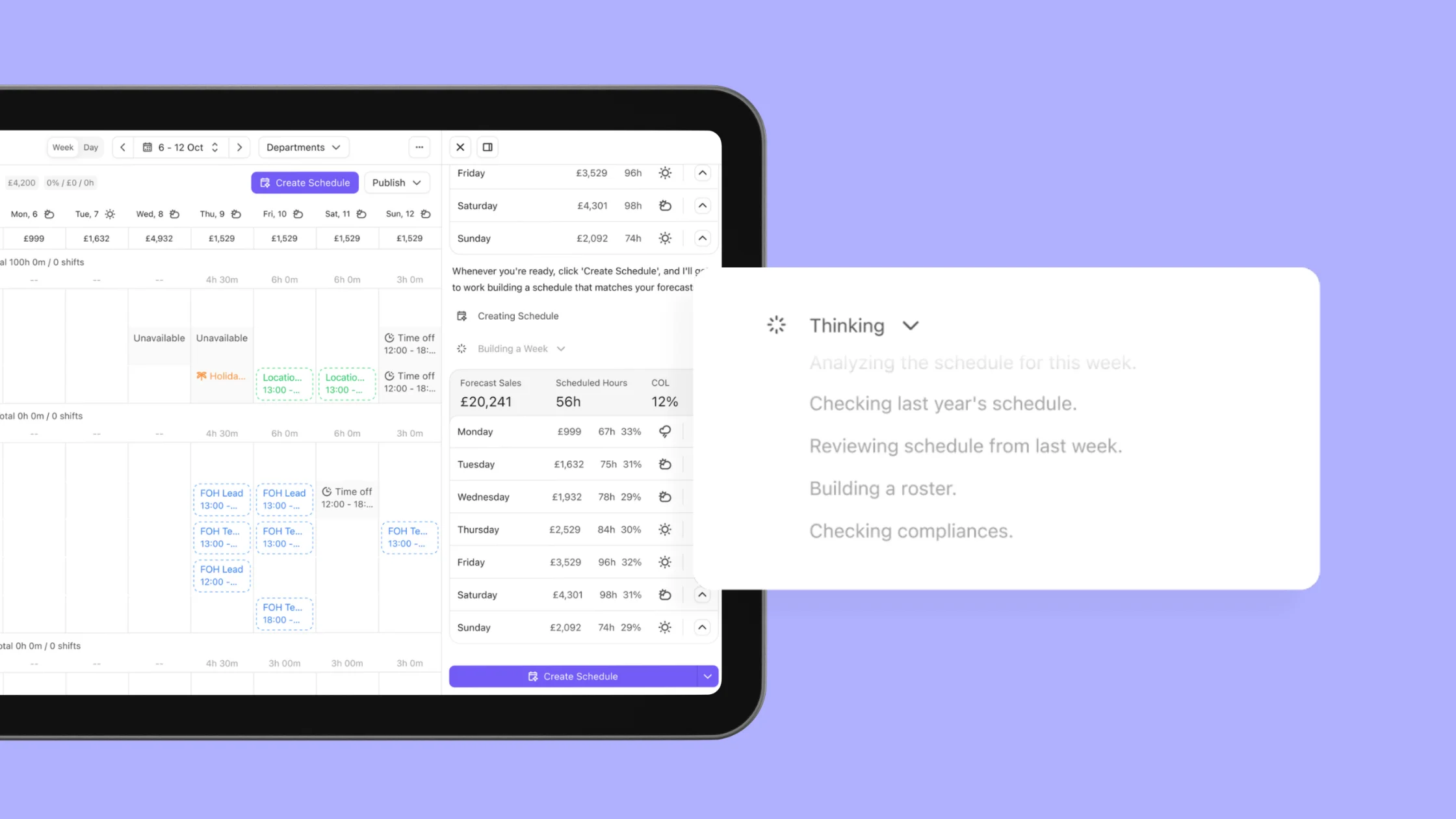
Introducing Nory’s AI Scheduling Assistant for restaurants

Scheduling is one of the most important decisions you make every week. And yet, in most restaurants, it is still one of the least systemised.
Managers build rotas based on availability, last week’s schedule, and instinct. It works on the surface, but underneath it creates a problem most operators never fully see.
The same sales day can produce completely different schedules across sites. Not because managers don’t care - but because there’s no system behind the schedule.
The real issue isn’t time - it’s inconsistency
Scheduling is often framed as a time problem. Managers spend hours building rotas, adjusting shifts, and trying to stay within labour targets.
But time isn’t the real issue. The outcome is.
Two managers can look at the same sales day and arrive at completely different schedules. Not because one is right and the other is wrong, but because each is relying on their own judgement.
You see it clearly when you look across sites.
Take a £3k Tuesday:
- One site overstaffs
- Another understaffs
- Another gets it right
Each decision makes sense locally. But across an estate, that variation creates inefficiency that only shows up later in your P&L.
By the time you see it, the decisions that caused it have already been made.
A shift from habit to system
Operators are starting to rethink scheduling entirely.
Instead of asking “Who’s available?”, the better question is: what does the business actually need?
That shift - from availability-led to demand-led scheduling - is what creates consistency. It allows operators to align labour to real trading patterns, rather than relying on instinct or memory.
Once you make that shift, scheduling stops being reactive. It becomes something you can control.
Introducing our AI Scheduling Assistant
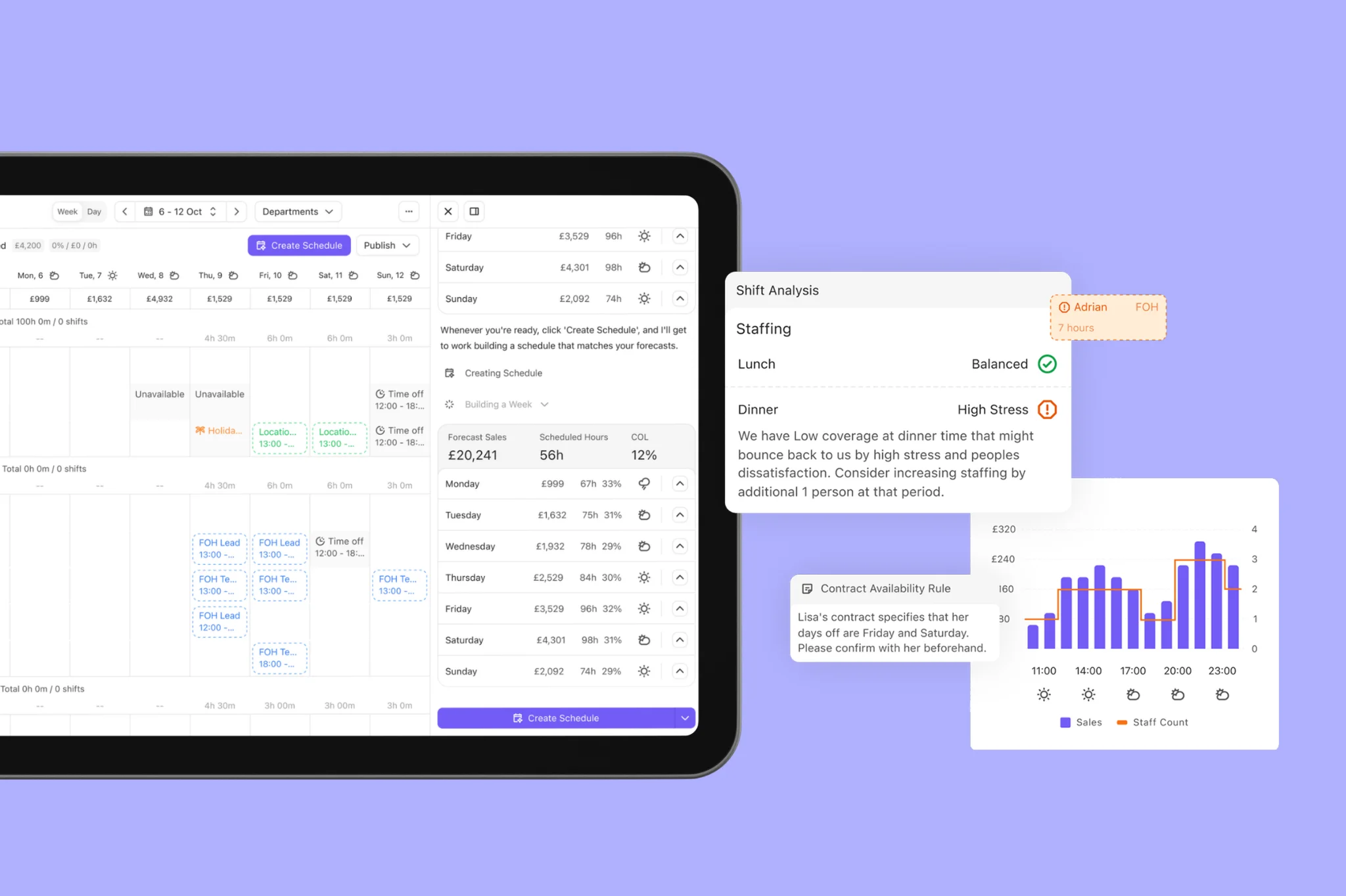
Nory’s AI Scheduling Assistant is built around this idea, and forms part of a broader agentic system designed to help operators take control of their prime costs.
It starts with your demand forecast, applies your operational rules, and generates a restaurant-ready schedule automatically. Your GM reviews it, makes adjustments if needed, and publishes.
The process doesn’t change dramatically. But the starting point does.
That’s where the impact begins.
What changes
- Consistency across sites - Same demand leads to the same labour deployment
- Better productivity - Staffing aligns to real sales patterns
- Less time spent scheduling - Minutes instead of hours
In pilots, operators have seen 5–11% labour cost savings - without cutting headcount. The improvement comes from scheduling more consistently, not restructuring teams.
Before this, a manager might spend two hours building a rota, adjusting shifts, and trying to stay within labour targets.
With a demand-led schedule, that same manager opens the rota to find it already built around expected demand. Instead of starting from zero, they’re making a handful of adjustments and publishing.
The difference isn’t just time saved. It’s the confidence that the schedule is grounded in reality.
Why this works
In practice, the biggest change is consistency.
Once that consistency is in place, labour is deployed in a more predictable and repeatable way across sites. That consistency improves productivity, reduces unnecessary labour spend, and gives managers time back every week.
The gains don’t come from cutting teams. They come from removing inefficiencies that have always existed but were difficult to see.
Built for real operations
Our AI Scheduling Assistant doesn’t replace your GM. It supports them.
Managers stay in control, making final decisions based on their site. The system removes the heavy lifting, not the judgement.
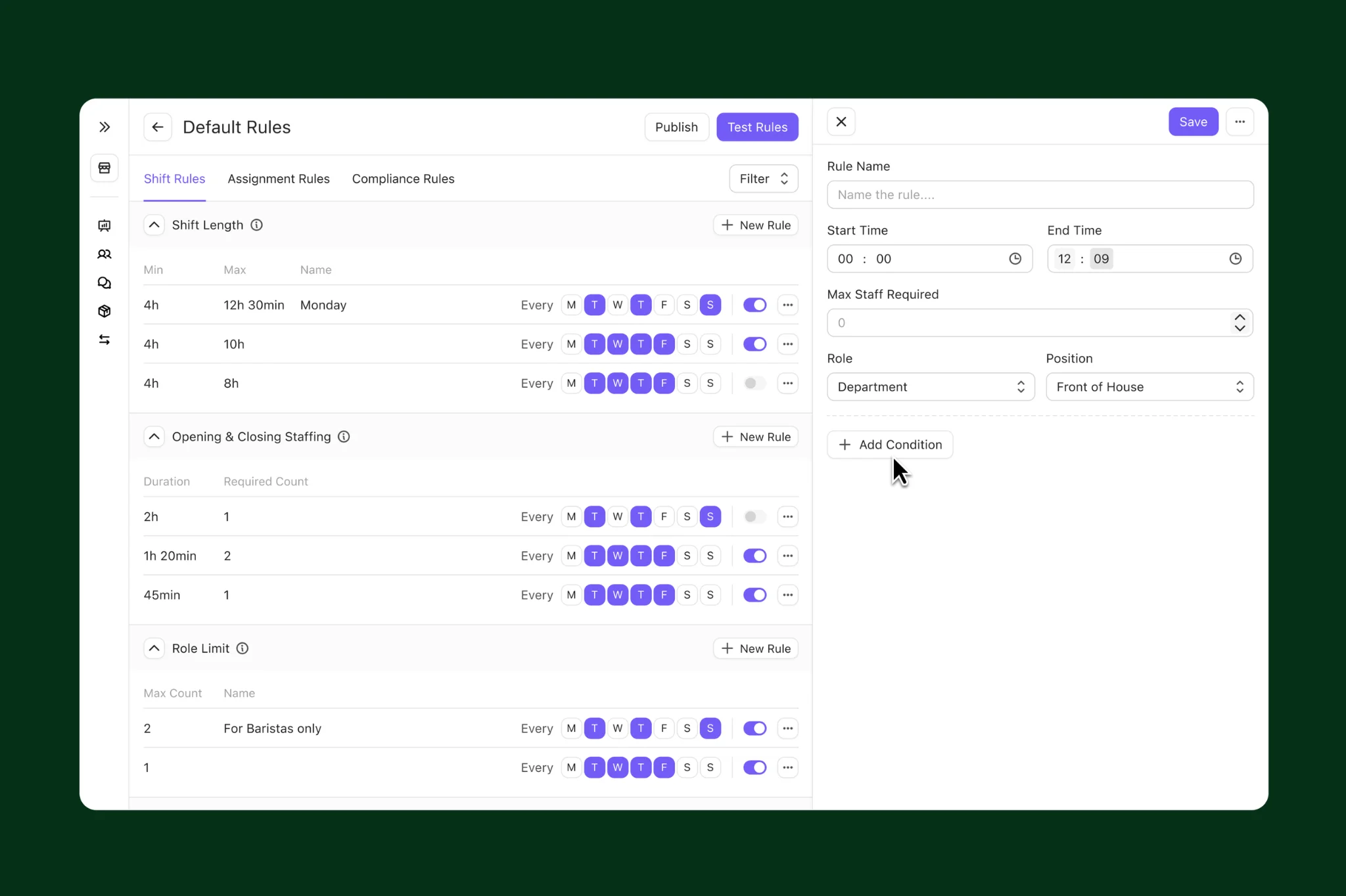
With our new Command Centre, they can define scheduling rules, test them against real locations, preview the impact, and deploy updates across the estate themselves.
It’s not just a configuration layer. It’s a way to standardise how scheduling works across every site, without depending on individual habits or any vendor intervention.
Instead of relying on external teams to configure and update your scheduling model, operators can define rules, test changes, and deploy improvements themselves - in minutes, not weeks.
One of the most common reactions from experienced managers is hesitation.
“I’ve been doing this for 15 years. I know my team.”
And they’re right. Local knowledge matters.
But when those managers see a schedule that reflects demand more accurately than their own starting point, the role shifts. They stop building from scratch and start refining something that’s already close.
Over time, outputs improve as the system learns how each location operates.
For multi-site operators, this goes further. Central teams can define scheduling rules, test them against real data, and roll them out across sites. Scheduling becomes consistent, measurable, and improvable - not dependent on individual habits.
The bigger shift
Scheduling has always been treated as a weekly task. But it’s becoming something more important: a lever for profitability.
Because the biggest gains don’t come from cutting staff. They come from matching the right people to actual demand - every single week, at every site.
If your scheduling still depends on habits, it’s likely costing you.