5 ways to use restaurant software to increase profit and cut costs

Running a restaurant means juggling tight margins, rising costs, and unpredictable demand all while keeping customers happy. Every decision, from how you schedule staff to how you price your menu, impacts profitability.
But here’s the good news: the right restaurant software helps you predict demand, reduce waste, and optimise performance.
Keep reading to learn how to use the right restaurant software to increase profits (and which tools should be on your radar).
Key takeaways about how restaurant software increases profit
- The best restaurant software links sales, labour, and inventory data in real time, so you can see where to cut costs and where to invest for the best results.
- Restaurant software with AI functionality can predict demand, manage rotas, and order inventory to optimise your spending without manual input.
- With clear visibility into performance, restaurant management software lets you adjust menus, pricing, and staffing quickly to protect margins.
- Nory’s restaurant operating system uses agentic AI to automate core restaurant operations (such as forecasting, staffing, and inventory management) to continuously optimise performance in real time.
5 ways to boost profits with the right restaurant software
The right restaurant software helps you run your restaurant more smoothly, make data-driven decisions, and uncover savings you might otherwise miss.
Here are five key areas where the right tech makes a measurable difference to your bottom line.
1. Reduce food waste with better inventory management
Food waste is one of the biggest profit killers. Every ingredient that expires or gets thrown away eats into your margins – literally.
You might not notice it daily with a few spoiled vegetables here and an over-ordered case of meat there. But over time, it adds up.
In fact, the hospitality sector is responsible for 800,000 tonnes of food waste every year.
The solution? Inventory management software.
Smarter inventory management software gives you the data you need to control waste and cut costs. By syncing directly with your POS, they connect purchasing and sales in real time, showing you:
- What’s selling
- What’s sitting
- Where to make changes to boost profits
Nory, for example, tracks every ingredient that comes in and goes out of your kitchen. The software integrates with POS systems like Toast so you can see exactly what’s selling in real time.
That means you always know what’s left in inventory and reorder only what you need.
Nory’s agentic AI system also predicts demand by combining historical data, live operational signals, and continuous learning to generate site-level forecasts. These forecasts are constantly updated and refined as new data comes in, so the forecast reflects what’s happening right now instead of what happened last week.
The AI agents can also break demand down into specific time windows and menu items. As a result, you see how much demand is coming, but also when it will arrive and what customers are likely to order.
Those predictions are then used directly by other parts of the system (like staffing and inventory) so decisions automatically align with expected demand rather than being planned in isolation.
Nory in action: Artisanal Gelato producer Badiani achieved 96% sales forecasting accuracy after using Nory to centralise inventory orders across multiple sites. As a result, they optimised ordering and production, significantly reducing waste and improving margins.
2. Control labour costs through AI scheduling
Restaurant staffing is a huge cost for any hospitality business and one of the hardest to manage.
Overstaffing leads to overspending on wages and cutting into profits. And understaffing? You risk slow service with a stressed workforce and unhappy customers. Getting the balance right can make or break your margins.
This is where agentic AI systems come in.
Nory’s AI operating system, for example, uses real data (customer trends, weather patterns, local events) to forecast sales and automatically build demand-based schedules. Instead of relying on guesswork, managers ensure the right number of people are working at the right times.
The results? Optimal spending on wages without cutting into profits.
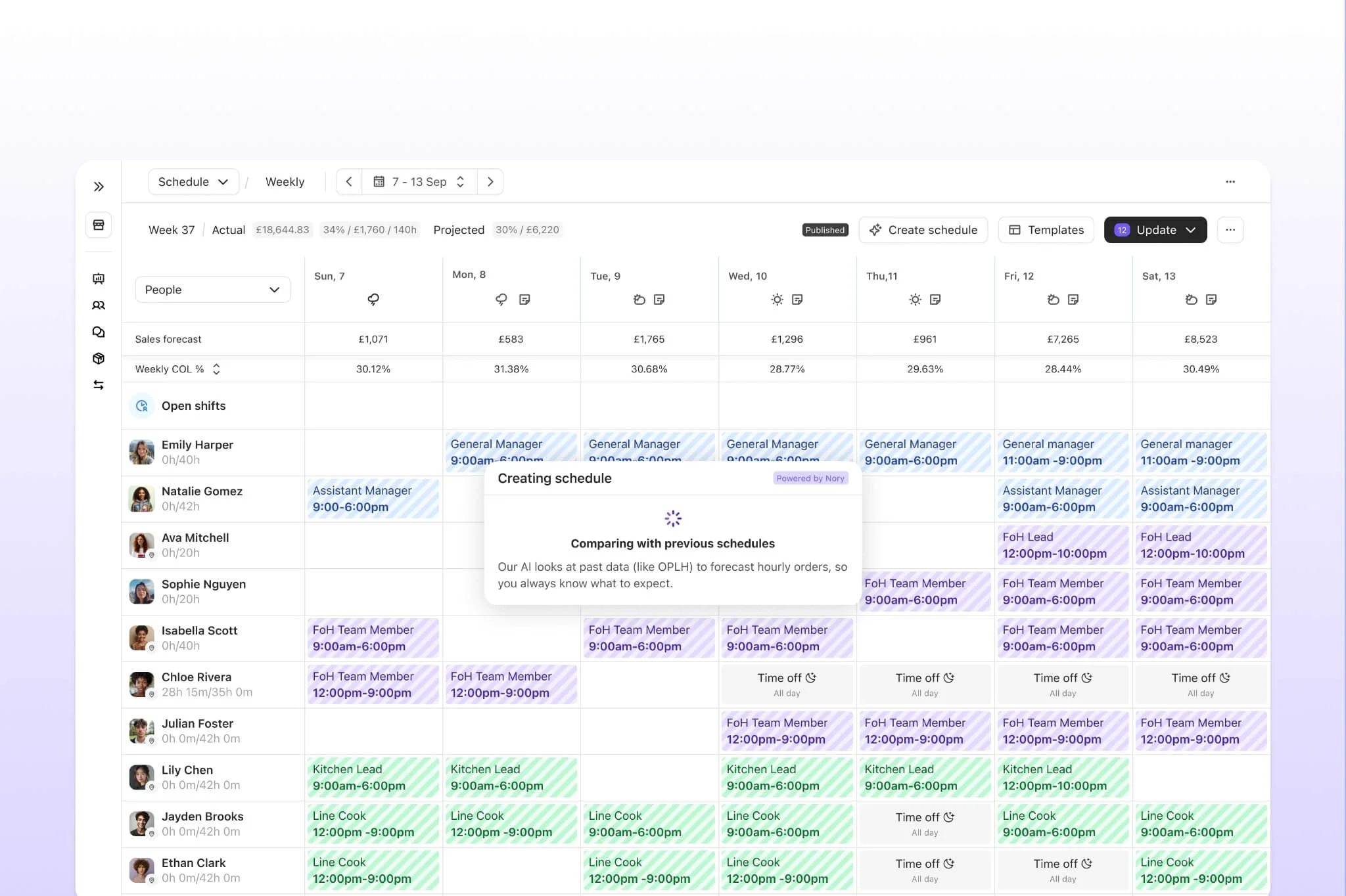
Nory in action: Take a look at Roasting Plant Coffee as an example. The fast-growing international coffee brand partnered with Nory to streamline its labour planning.
Before using Nory, store managers relied on manual rotas, often overstaffing slower shifts. Nory’s workforce management software uses AI forecasting to analyse footfall, booking data, and historical sales to predict demand.
By switching to Nory’s AI-driven scheduling, the business reduced labour costs by 18% in just two months.
3. Use data to optimise your menu
Menu optimisation tools help you understand exactly which dishes drive and drain profits. By combining sales data with ingredient costs, these platforms reveal the true performance of every menu item.
For example, if your most popular pizza suddenly drops in profitability due to rising cheese prices, the software flags it instantly. You can then adjust pricing, portions, or suppliers before it affects your bottom line.
The software can also identify high-margin ingredients and dishes that are well, allowing you to promote them strategically and boost profits. By spotlighting profitable items, restaurants can nudge customers toward dishes that have the biggest impact on the bottom line.
For instance, if a specialty pasta sells well and delivers strong margins, your restaurant could promote it on social media. Boosting awareness of this menu item leads to more interest and higher orders, increasing footfall and margins.
Nory in action: Masa, an authentic Mexican restaurant, used Nory to centralise its operations tech stack and gain clearer visibility over sales, inventory, and labour. After implementing Nory, Masa achieved 97% sales forecasting accuracy.
This data accuracy allowed the brand to make better menu-pricing decisions, adjust portions and ingredients in near-real time, and protect margins while maintaining guest experience.
4. Speed up operations to improve table turnover
Every extra table you turn in a shift adds directly to your revenue. But slow service, long wait times, or inefficient communication between the kitchen and front of house can hold you back.
Restaurant operations software helps you streamline service from start to finish. Modern point-of-sale (POS) systems, kitchen display systems (KDS), and handheld ordering tools keep everything moving smoothly.
Imagine a mid-sized restaurant during peak dinner service. The restaurant doesn’t have restaurant tech in place, so here’s what service looks like:
- Orders are placed manually
- Servers walk back and forth to terminals
- The kitchen prints paper tickets and communicates via runners
Because of these slow and manual operations, table turnover isn’t as efficient as it could be.
With the right technology (like a mobile POS and KDS setup), the restaurant speeds up these processes. As a result, they increase table turnover times and allow more room for additional diners, leading to more revenue for the business.
Nory in action: UK coffee-shop group Josie’s implemented Nory to unify its workforce and inventory operations. Within four months, they reduced labour costs by 23% and boosted sales per labour hour by 20.5%.
5. Real-time dashboards to monitor costs
Running a restaurant without real-time data is like flying blind – you can’t see problems until it’s too late.
Modern restaurant management software puts all your data in one place, giving you instant visibility into sales, labour, and food costs. Instead of waiting for month-end reports, managers can see exactly how the business is performing hour-by-hour.
But here’s where it gets tricky: a lot of restaurant software vendors talk about “real-time” dashboards when they actually mean something very different.
There are a few different levels of data freshness, and they change what you can actually do with the information:
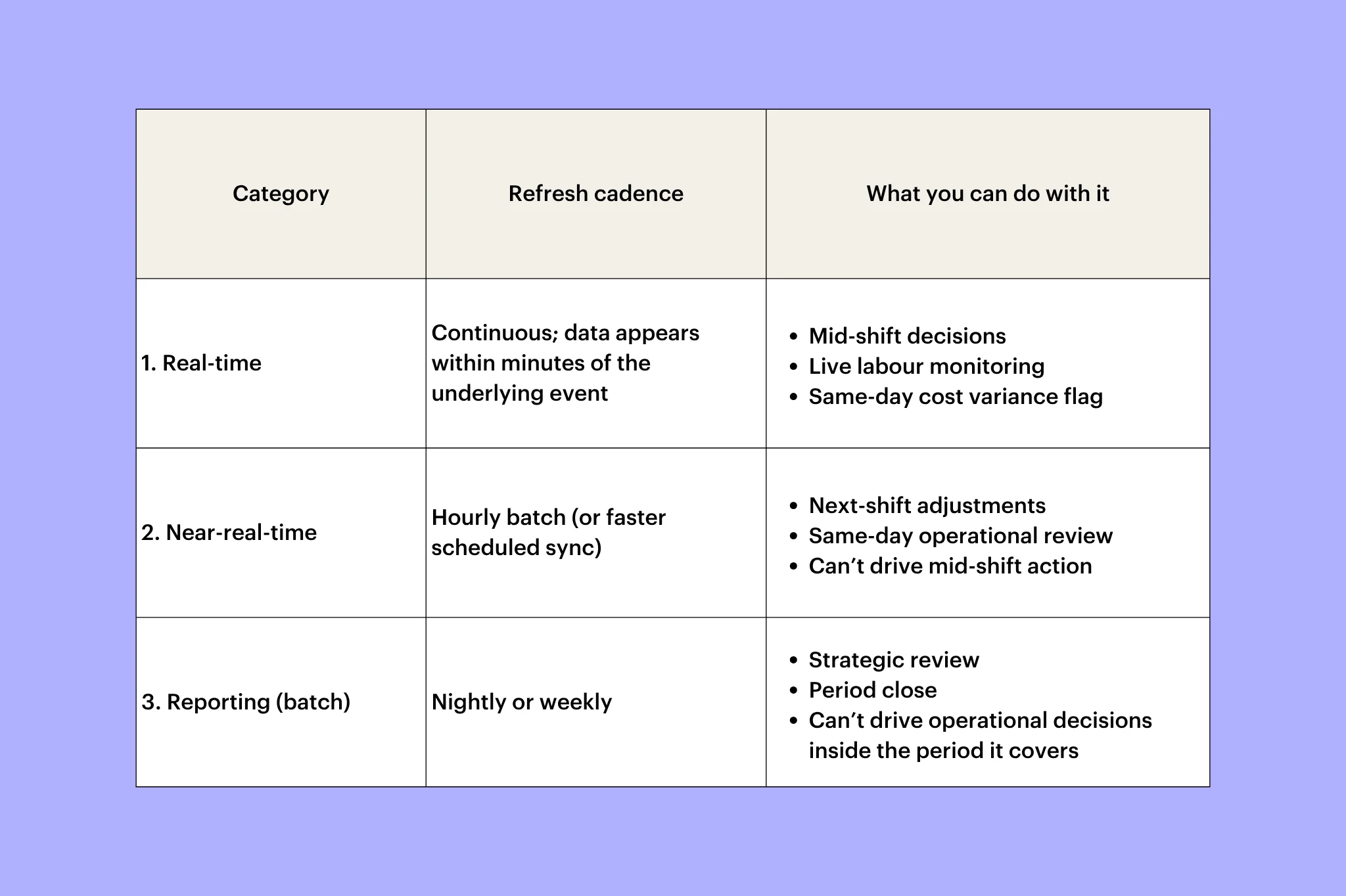
The issue is that many systems marketed as “real-time” actually fall into the second or even third category. For operators, this means you invest in a tool expecting live operational visibility, but the data arrives too late to influence what’s happening on the floor.
The result is missed opportunities to control costs in the moment and decisions that are always reacting to yesterday, rather than shaping today.
With Nory, operators have access to actual live, real-time data. The platform continuously updates with the latest data so you can track every cost in real time. From here, you can react quickly to trends to improve your bottom line and remain profitable across sites.

Nory in action: Rocksalt, a multi-venue cafe and restaurant group across Ireland, used Nory to unify its labour management, sales forecasting, and supplier management. As a result, the business:
- Reduced labour costs by 7%
- Achieved 97.5% sales-forecast accuracy
- Reduced the time spent monitoring supplier prices
The real-time visibility from Nory’s live dashboards means that operators have better cost-control, faster reactions to trends, and better margins.
Best restaurant software for profitability: 3 of the top tools on the market
The best restaurant software should directly improve profitability by reducing labour waste, tightening inventory control, and increasing sales efficiency.
Below are three key platforms worth your consideration:
1. Nory: Best agentic AI system for multi‑location restaurants
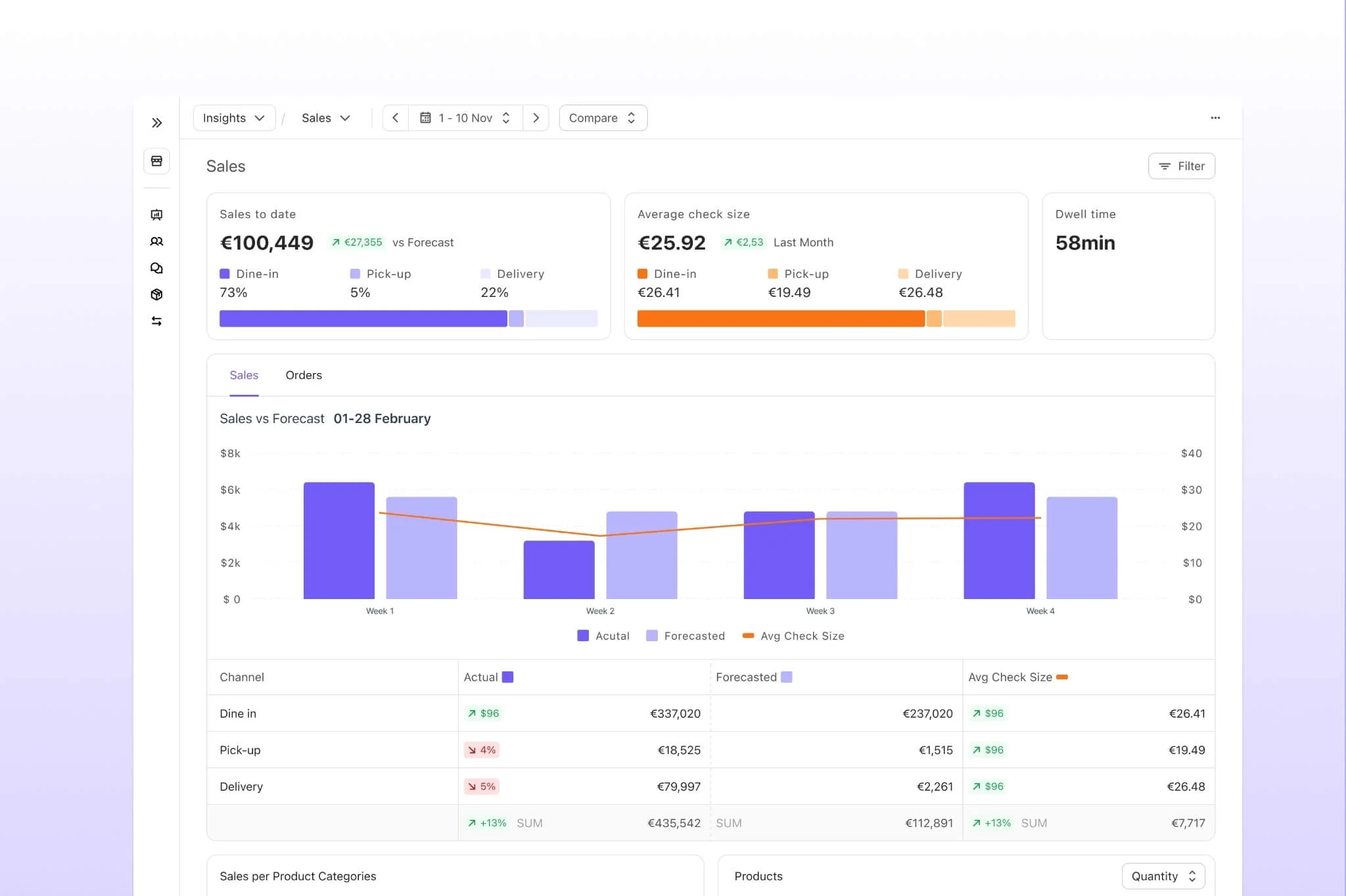
Nory combines everything you need to run your restaurant smoothly into one easy-to-use platform. From inventory and workforce scheduling to menu analytics and real-time dashboards, Nory provides you with real-time, accurate data to make informed decisions about spending, scheduling, and more.
Nory’s AI agents (like the Scheduling Assistant) also forecast demand, labour, and ingredient usage with impressive accuracy. This means operators can plan ahead with a clear view of what’s likely to happen next and adjust operations proactively to keep profits healthy.
The software is perfect for operators who want to bring together all their moving parts (like stock management, sales performance, and staffing) into one location.
And another benefit? Nory integrates with your existing systems. You keep the tools that already help you manage your operations, while gaining powerful insights that help you save costs and boost performance.
2. Toast: Best for front of house
.webp)
Toast is a full‑featured cloud‑based digital ePOS built for restaurants. The software covers tableside ordering, handheld devices, kitchen display systems, payments, customer loyalty and more.
If your primary challenge is streamlining guest interactions and managing tableside service, Toast is a strong choice. The software increases ROI by speeding up service, reducing errors, and boosting repeat visits through loyalty and personalised guest experiences.
Fun fact: Nory seamlessly connects with Toast to unify customer data, track loyalty rewards, and give real-time insights into guest behaviour. This integration empowers your team to deliver faster, more personalised service that keeps diners coming back.
To sum it up: If you use Toast for ePOS or front‑of‑house management, you can feed that data into Nory to get operational analytics (labour vs sales, inventory usage, and so on).
With these insights, you can make smarter decisions to optimise staffing, reduce waste, and increase your ROI.
3. Shift4: Best for payment infrastructure
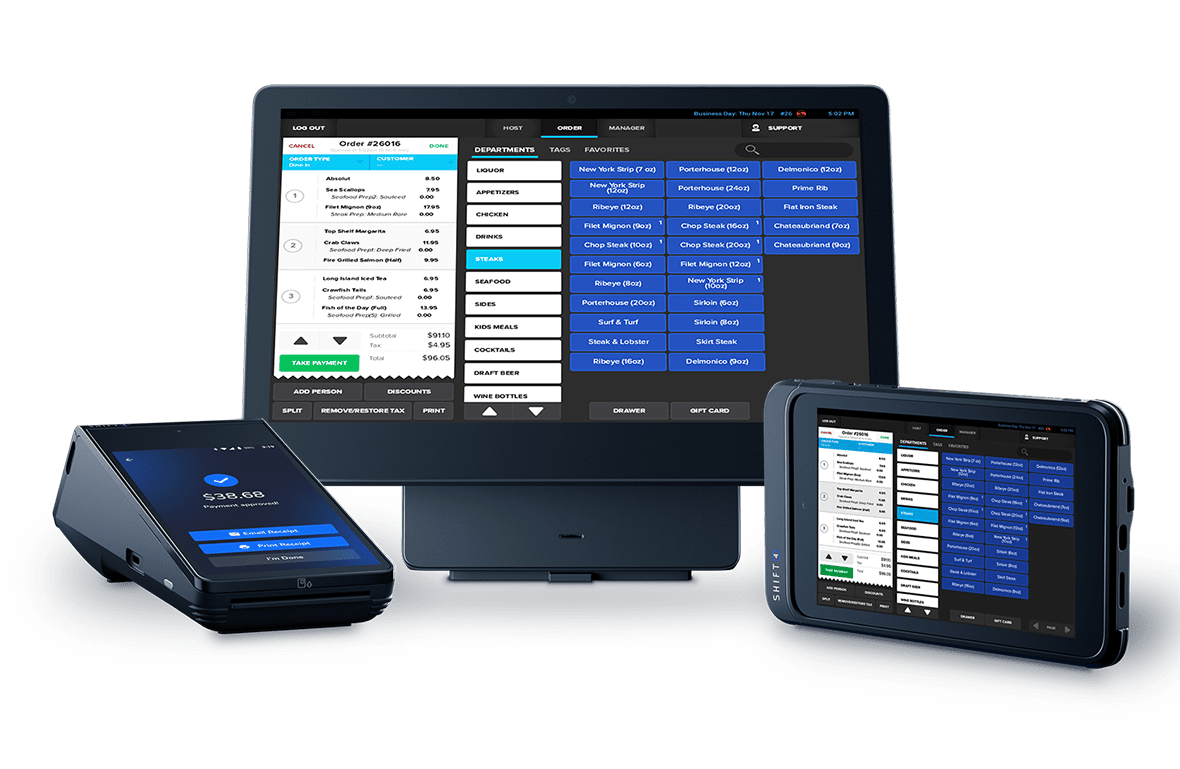
Shift4 delivers a robust POS and payments ecosystem (SkyTab) that helps restaurants streamline transactions across multiple locations and simplify back-office operations.
The hardware-integrated system ensures payment reliability, speed, and security. This functionality is essential for growing operations with high transaction volumes.
Shift4 is ideal for restaurants that need dependable payment processing and effortless scalability across multiple sites. The software boosts ROI by cutting payment errors, reducing admin time, and giving you clearer insights into performance across every location.
Fun fact: Nory integrates directly with Shift4 to sync real-time restaurant sales, labour, and inventory data into one platform. This integration gives you instant visibility into your restaurant’s performance without manual entry or data duplication.
To sum it up: With Shift4 handling transactions and Nory powering analytics, you get a complete operational picture. As a result, you can make faster, data-driven decisions that improve efficiency and profitability across every site.
FAQs about how restaurants increase profits with technology
1. How does restaurant software improve decision-making for owners and managers?
Restaurant software improves decision-making by combining key business data (sales, costs, staffing, and supplier performance) into one place. This means that operators can spot trends earlier and act with confidence instead of relying on gut feel or fragmented reports.
2. Can restaurant technology improve supplier and procurement efficiency?
Yes! Modern restaurant systems help operators compare supplier pricing, track purchasing patterns, and identify inconsistencies across locations. This makes it easier to negotiate better deals, standardise purchasing, and reduce unnecessary cost variations between sites (all of which directly improve margins without changing operations on the floor).
3. How does restaurant software support multi-location growth?
The right software standardises operations across sites by centralising reporting, performance tracking, and forecasting. This allows operators to benchmark locations, replicate high-performing behaviours, and quickly identify underperforming sites. The result is more consistent execution and faster, more controlled scaling.
4. What are the restaurant management software benefits?
Restaurant management software helps streamline daily operations by bringing things like reservations, staffing, inventory, and reporting into one place. It reduces manual admin, improves accuracy, and helps teams make faster, data-driven decisions. The result is better efficiency, lower costs, and a smoother experience for both staff and customers.
How smarter restaurant systems drive better results
Profitability in hospitality comes down to precision. Controlling costs, predicting demand, and running operations efficiently are a few examples. The right software turns data into decisions, helping you reduce waste, optimise labour, and boost revenue.
Nory brings all of these insights together. The agentic AI system centralises inventory, scheduling, forecasting, and performance dashboards, giving you full visibility across every site.
With seamless integrations to leading POS and payment systems, Nory helps you make faster, smarter choices that directly improve your bottom line.
Book a chat with the team to see how Nory boosts profitability.