Multi-site restaurants have a compliance problem. Here's what it actually looks like.

The first time you open a restaurant in a new location, compliance feels manageable.
You do your research. You speak to someone in HR. You look up the overtime rules, or the working time regulations, or the national minimum wage. Maybe you hire a consultant. You get it sorted.
Then you open the second. And the third. And by the time you're operating across five locations, whether that's five states or five countries, you've got multiple sets of rules to know, track, and apply. They're all slightly different. They all change.What starts as a compliance task becomes a structural problem.
The rules aren't simple, and they're not stable
Working time regulations, break requirements, days of rest, minimum wage rates that differ by city, by region, by year: none of it is simple, and none of it stays still.
In the US, this means navigating a patchwork of federal, state, and local law. Overtime rules differ between states. Predictive scheduling requirements in New York City, Chicago, and Seattle don't apply two states over. Tip credit rules vary by state and sometimes by city. Minimum wage floors change annually, and not always on the same date.
In the UK and Ireland, it means Working Time Regulations, National Living Wage bands, mandatory rest breaks, holiday pay calculations, and rules around casual and zero-hours contracts that are frequently tested by employment tribunals. In the EU, the Working Time Directive sets a baseline, but each member state applies it differently.
Every one of those rules can change with little warning, and there's a lot of paperwork (and potential fines) involved if you get it wrong.
Labour compliance violations cost restaurant groups hundreds of thousands of pounds and dollars a year in back-pay claims, fines, and legal fees. The businesses that get caught out aren't always the ones operating in bad faith. They're often the ones who were compliant last year but didn't catch the update.
Your HR team wasn't hired to be labour lawyers
Here's what compliance actually looks like inside a growing multi-site operation.
Your Head of HR spends part of their week checking schedules against local regulations: not strategic work or supporting your people, but checking that the rota for location seven doesn't accidentally violate the overtime threshold that changed in your newest market three months ago.
Your General Managers are publishing schedules without really knowing if they're compliant. Not because they don't care, but because they're running a restaurant, not a law firm. They trust the system and most systems don't give them the information they need.
When a new location opens, whether that's a new state or a new country, it's a scramble. Someone finds the right information, patches it in, and hopes it holds. It's an approach that works once, maybe twice, and then stops keeping pace with the growth.
The invisible cost nobody talks about: your COL is probably wrong
Here's the part that tends to surprise operators.
When your scheduling tool doesn't account for jurisdiction-specific labour contributions and premiums, including tip credits, employer National Insurance contributions, state-specific overtime, and country-specific payroll obligations, your Cost of Labour figures are off. Meaningfully off.
That means the data you're using to make scheduling decisions isn't fully accurate, the P&L you're reviewing isn't fully accurate, and every time you look at your labour cost percentage and wonder why it doesn't match reality, this is part of the reason.
Compliance isn't just a legal risk. It's a data accuracy problem that sits inside every decision your operations team makes.
The expansion playbook breaks under pressure
Every new location is its own compliance project. A new state brings its own overtime rules, break requirements, and minimum wage floor. A new country brings an entirely different legal framework: employment rights, working time law, national wage bands, and a new set of payroll obligations.
Each one takes time your HR team doesn't have and creates risk your business can't afford. The operators who were compliant at launch often drift non-compliant as they scale, not through negligence, but because the process doesn't keep up with the growth. That's the gap: not effort, not intent, but process.
Compliance that works by default, not by luck
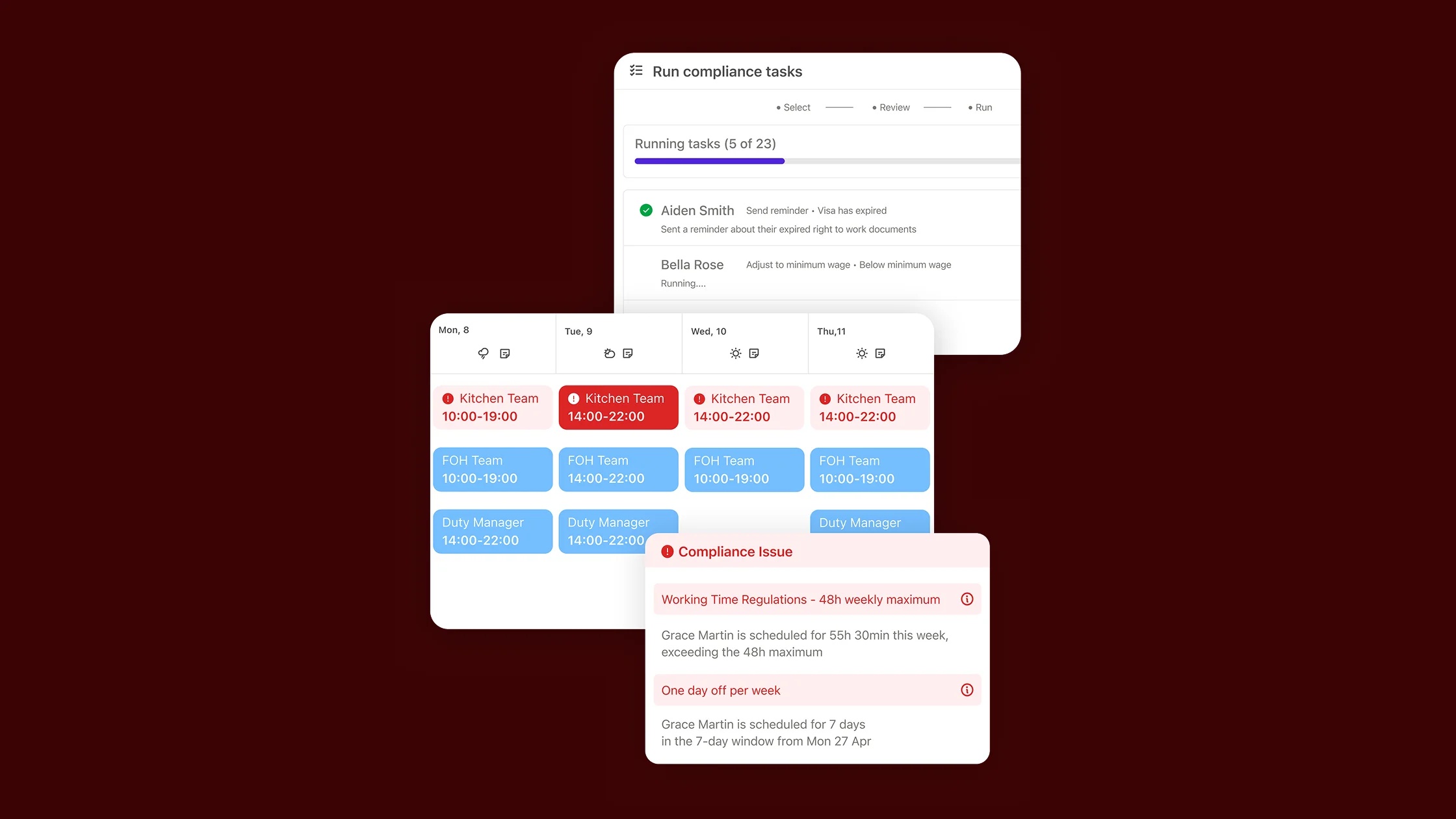
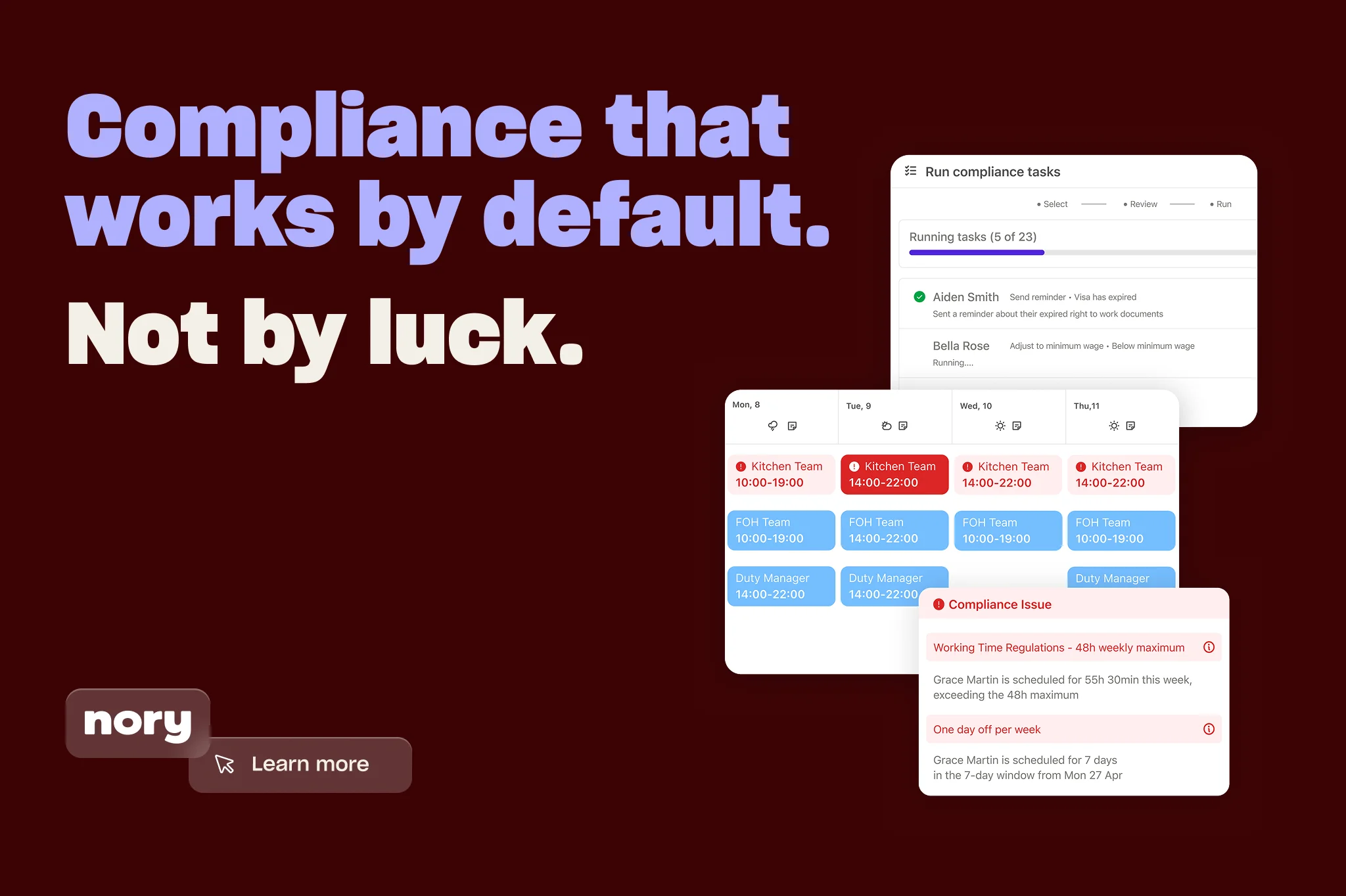
Running restaurants in multiple locations means juggling compliance rules that change by city, by state, and by the year. Nory's Compliance Assistant automatically applies the right workforce rules (overtime, breaks, minimum wage, and more) to every location, so your schedules are compliant from the moment you hit publish. No spreadsheets. No guesswork. No risk.
Nory's Compliance Assistant is coming soon. Learn more now.
Frequently asked questions
What are the main labour compliance requirements for restaurants operating across multiple US states?
Every state has its own rules on overtime thresholds, break entitlements, minimum wage, and in some cases predictive scheduling. Federal law sets a floor, but states like California, New York, and Illinois go significantly further. Multi-state operators need to apply the correct rules for each location, and those rules change regularly.
What are the working time regulations for restaurants in the UK?
Under the Working Time Regulations 1998, workers are entitled to a 20-minute rest break for any shift over six hours, 11 hours of rest between working days, and an average working week of no more than 48 hours (unless they've individually opted out). Paid annual leave entitlements also apply from day one of employment, to full-time, part-time, and casual workers alike.
How do labour compliance rules change when expanding a restaurant from the US to the UK or Ireland?
The UK and Ireland operate under different legal frameworks entirely. There's no federal/state split as in the US, and employment law is set nationally (with some variation in Northern Ireland). Expanding operators need to account for Working Time Regulations, National Living Wage, statutory rest breaks, holiday pay calculations, and employer obligations around payroll (PAYE and National Insurance in the UK; PRSI in Ireland). A compliance setup built for the US won't transfer directly.
What are the biggest compliance risks for a multi-location restaurant group?
The most common issues are applying the wrong overtime rules when entering a new state or country, missing minimum wage increases when they take effect, non-compliant scheduling (inadequate breaks, insufficient rest periods, maximum hours breaches), and inaccurate holiday pay calculations. Each carries legal and financial exposure, and in multi-site groups, errors tend to replicate across locations before they're caught.
What happens if a restaurant is found to be non-compliant with labour law?
Penalties vary by jurisdiction but typically include back-pay obligations, fines, and in some cases legal action from employees. In the UK, failure to pay the National Minimum Wage can result in HMRC penalties of up to 200% of the arrears, plus public naming. In the US, violations of the Fair Labor Standards Act can result in back wages, liquidated damages, and civil penalties. Repeat violations carry higher penalties in most jurisdictions.