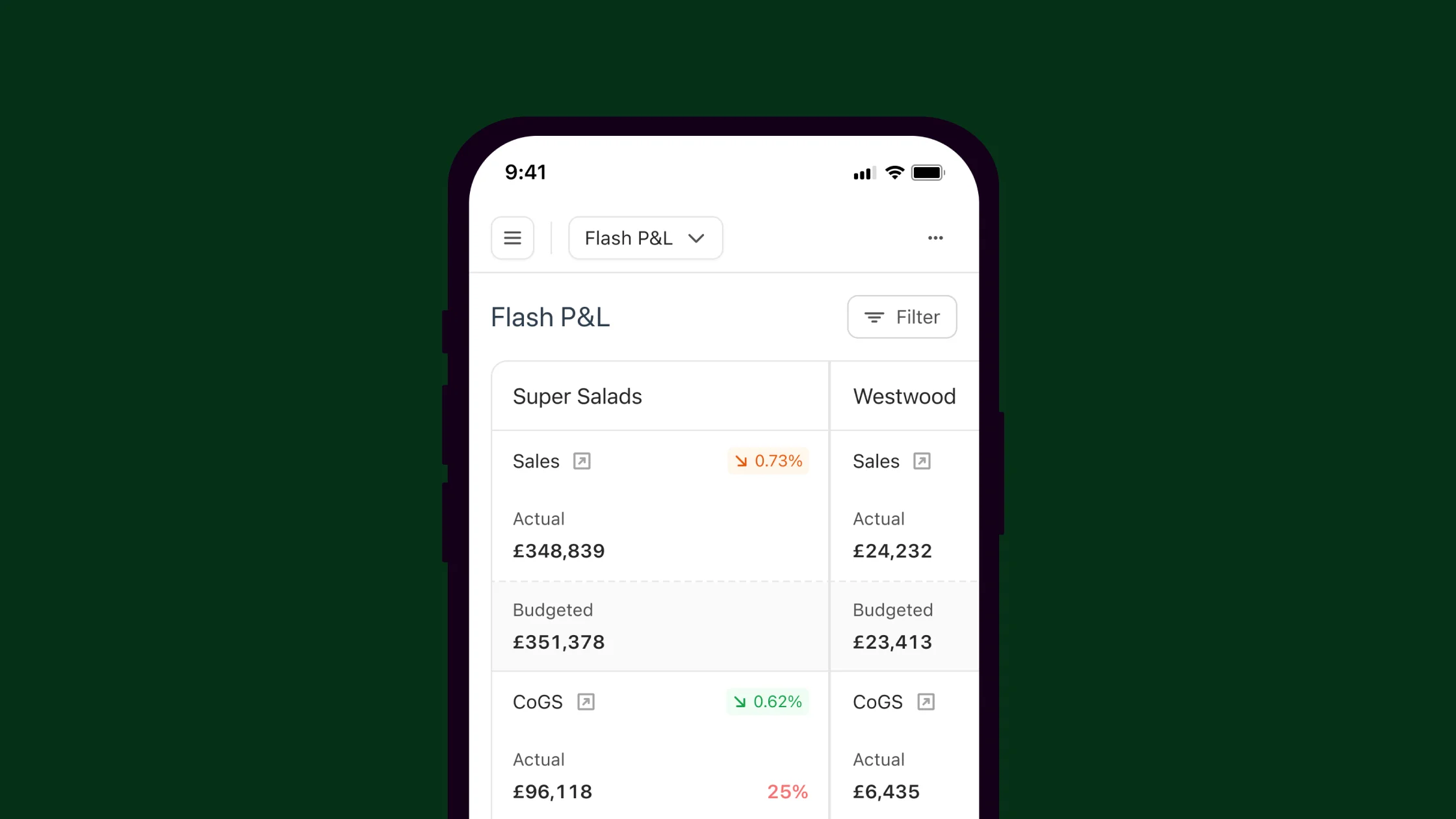

Real-time P&L for restaurants: Why weekly reports aren't enough

Most restaurants make decisions about their bottom line based on a P&L that’s already out of date.
By the time your weekly reports land on Monday morning, the events that produced those numbers happened 5 days ago. You're reading about all of it on Monday, and you're meant to make decisions about this week based on what last week told you.
So what’s the solution here?
To put it simply, real-time restaurant P&L reports.
In this article, we break down what restaurant live P&L means in practice. Find out why weekly reporting falls short for multi-site operators and the architectural shift required to move from lagging dashboards to genuinely operational, in-the-moment financial visibility.
What "real-time" actually means in restaurant P&L
A real-time restaurant P&L continuously pulls and displays operational data within minutes, not hours or days.
A lot of restaurant tech vendors use the term “real-time” loosely. It’s become a buzzword that means very different things from one platform to another.
You need to understand the differences between these definitions to know how current and actionable your data is.
Here are some of the common definitions (spoiler alert: most “real-time” claims in restaurant tech are actually category 2 or 3):
The mistake a lot of operators make is buying a batch tool that says it's real-time and being shocked when the operational team can't make decisions because the data isn’t as up-to-date as expected.
How to test if your P&L data is actually real-time
Open the dashboard at 3pm on a Saturday:
- If you can see what's happening at the till right now, the labour cost as it's accruing, the variance against forecast as the service unfolds, that's real-time.
- If you can see this morning's numbers but the afternoon is missing, that's near-real-time.
- If you can only see yesterday's totals, that's reporting.
Why most restaurant P&L isn't real-time (the architecture problem)
Most P&L tools can't provide real-time restaurant analytics because their systems weren't built for it.
A lot of business intelligence (BI) platforms aggregate data from your existing operational stack, like your POS system, scheduling tools, inventory systems, accounting platforms, and so on.
Each of those solutions has its own data refresh cadence:
- Your POS might sync hourly
- Your scheduling tool might sync nightly
- Your inventory tool might sync weekly
- Your accounting platform might sync at month-end
Your P&L dashboard inherits the slowest source.
So if any one of your underlying systems syncs on a 24-hour cycle, your "real-time" dashboard has a 24-hour ceiling, no matter how fast the dashboard itself refreshes.
The dashboard is fresh, but the data feeding it isn't.
This is the reason real-time claims tend to be marketing rather than reality. The vendor isn't lying about their dashboard refresh rate, they're just not telling you that the data flowing in is on a different cadence entirely.
This is where generated data comes into play.
An operating system that manages forecasting, scheduling, ordering, and payroll directly already has the data it needs, so there’s nothing to sync. The data comes from within the platform as the operational events happen, and the dashboard shows it instantly.
This type of system is the only one that supports true real-time in restaurant P&L.
What changes when your P&L is genuinely real-time
A real-time P&L changes how quickly you can respond to what’s happening right now. You can make operational decisions while there’s still time to influence the outcome.
Here are a few examples:
- Mid-shift labour adjustments. If sales are running light at 4 p.m., you can adjust staffing levels before costs lock in. If a Friday lunch is busier than expected, you can bring in cover while it still matters.
- Same-day food cost variance flags. If a supplier delivery comes in over expected cost, you can flag it and challenge it immediately, not days later when the stock is already used.
- Live prime cost monitoring. Watch labour and COGS as the day unfolds, meaning you can build against target throughout the day and correct course while there’s still time.
- Verify predictions at the end of the week. With real-time data, weekly reviews stop surfacing surprises. You already saw the issues as they happened and dealt with most of them in the moment. The weekly view becomes a check that everything added up as expected.
For a single-site operator with predictable demand, reviewing profit and loss statements once a week may be enough. But once you're managing multiple locations? Delays become much more expensive.
Every site generates its own labour, food cost, and sales variances. By the time those numbers make their way into a weekly report, the opportunity to fix problems instantly and prevent profit loss has already passed.
Recommended reading: How the UK Budget will impact your restaurant’s P&L in 2026.
An honest list of what real-time isn't
Real-time P&L doesn’t predict the future, replace your finance function, or fix weak operations on its own. It’s about seeing what’s happening in your business faster so you can make the right call to protect your margins.
Let’s be clear about what it doesn't do:
- It’s not predictive. Real-time data shows you what’s happening now, not what will happen next. Sales forecasting is a separate capability. Useful, but different – don’t mix the two.
- It’s not accountant-ready. You’re not replacing your month-end close. Things like accruals, depreciation, and audit adjustments still live in the monthly finance process. Real-time P&L is for day-to-day operations, not statutory reporting.
- It’s not something you stare at all day. Instead of watching dashboards all day, the value usually comes from alerts (like labour running over 30% or food cost variance crossing a threshold) that prompt action when needed.
- It doesn’t fix poor operations. If a site is already disorganised, real-time data just shows the problem faster. It helps you see what’s going wrong, but it doesn’t solve it for you.
Real-time P&L is best thought of as a tool for faster decisions. It’s only as useful as the actions you take with it.
Why Nory is different: Real-time P&L that actually works
Nory is an agentic AI operating system built for multi-site restaurants. The system doesn’t just report on your restaurant operations, it actively runs them through AI Assistants with things like:
- Forecasting demand
- Building schedules
- Managing orders
- Processing invoices
- Handling payroll
- Supporting compliance
To sum it up: Nory’s operational layer lives inside the platform. The data is created inside the system as work happens, so the numbers are genuinely live and not stitched together from delayed integrations.
So when you open Nory’s live P&L view, you’re not looking at synced data or last-night’s batch update. You’re looking at what’s happening right now.
Take something simple like labour costs during a quiet shift. In most systems, you might only see overspending after the shift. In Nory, you can see labour building against sales in real time across every site and actually do something about it while service is still live.
Why this matters for multi-site operators
Once you’re running 2, 5, or 20+ sites, small delays stop being small problems and start growing into real dents in your profit margins.
That’s why multi-site operators like Hampshire Pub Co use Nory’s live P&L to stay closer to what’s happening in the business.
Like many growing restaurant groups, the business moved from a world of fragmented reporting (where each site had its own view of performance and insights arrived too late to act on) to Nory’s single live view of operations across sites.
The shift gave teams the ability to spot issues early, align decisions across locations, and respond to performance immediately.
We’ve now got proper data to back up our decisions when we look at another site.
Adam Lewis, Operations Manager at Hampshire Pub Co.
The restaurant group no longer had to wait until the end of the week to understand dips in performance. If labour started to creep during service, or if sales in one site were running behind forecast, those signals were visible as the shift was happening.
What does this mean for the business?
It means that managers and central teams could step in earlier, adjust staffing or operations in the moment, and prevent small variances from impacting the bottom line.
Since implementing Nory, Hampshire Pub Co has seen measurable improvements:
- ~50% reduction in labour admin time
- <1 hour spent on payroll admin time (previously ~2 days)
FAQs about real-time restaurant profit and loss
What is real-time restaurant P&L?
Real-time restaurant P&L (or a live restaurant P&L) means your key operational data (sales, labour, food cost, and prime cost) flows into your dashboard within minutes of it happening. The software performs real-time restaurant reporting so you can access key performance data as soon as it happens.
It’s not the same as “near real-time” (hourly updates) or standard reporting (daily or weekly batches).
The difference comes down to timing. Real-time helps you act during the shift, near real-time helps you adjust before the next one, and weekly reporting is mostly for review after the fact.
How is real-time P&L different from a weekly P&L report?
A weekly P&L tells you what’s already happened. By the time you see it, you’re usually looking at last week’s problems with no way to change them.
Real-time P&L shows those same issues as they unfold. For example, if labour is running high during a busy service, you can adjust staffing, cut hours, or rebalance the shift before overspending on wages.
Can my POS or accounting software give me real-time P&L?
For sales, yes – most modern POS systems update in real time.
For a full P&L, not really. A proper P&L pulls together labour, food cost, overheads, and accounting adjustments, and those usually sit in different systems.
The moment you combine multiple sources, you’re limited by the slowest one. So even if your POS is instant, your overall P&L usually isn’t.
What most tools call “real-time P&L” is really real-time sales plus delayed cost data.
What's the technical difference between real-time and near-real-time data?
Real-time updates happen as soon as something happens in the operation – a sale, a clock-in, a delivery, it’s all there.
Near real-time updates happen on a schedule, like every hour or every few hours.
In simple terms: real-time reacts to events, near real-time reacts to the clock. The difference is whether the system is built as one connected platform or stitched together from multiple tools.
Why do most "real-time" restaurant analytics tools have a sync delay?
Because most restaurant analytics tools pull data from several systems (POS, scheduling, inventory, accounting) and each one updates at its own pace.
The dashboard might refresh quickly, but the data feeding it doesn’t.
To truly remove that delay, the data has to be created and stored in the same system that displays it.
Act in the moment with Nory’s P&L reporting for restaurants
Real-time P&L gives operators the ability to see what’s happening in their business and respond while there’s still time to change the outcome. If your P&L only shows you last week’s performance, you’re always reacting too late.
Nory brings forecasting, scheduling, ordering, payroll, and reporting into one system, so operational data is created in real time as the business runs. For multi-site operators, that means fewer end-of-week surprises, faster in-shift decisions, and better control over performance across every site.
Book a demo to see how Nory helps you act in the moment with live P&L reporting.
Disclosure and methodology
This piece is published by Nory. We build an agentic AI operating system for multi-site restaurants, and the architectural argument above (generated data is the only path to real-time P&L) lands on the design we've built.
We're aware of that. We've tried to be honest about which definitions are universal (the three categories: real-time, near-real-time, reporting) and which are Nory-specific (the operating-system architecture as the path). Other vendors will land on different definitions, and that's fine.
The honest test for any vendor's "real-time" claim is the one in the second section: can you see what's happening at the till right now, the labour cost as it's accruing, the variance against forecast as the service unfolds? If the answer is no, the dashboard isn't real-time, no matter what the marketing says.