00:00:00
Gabriel Shohet
Everybody was talking about 100% arabica. We launched — we went completely against that trend and became the de facto black sheep of the coffee industry, particularly the specialty coffee industry. That's what our business is about still today.
00:00:15
Gabriel Shohet
Welcome back to What's Cooking.
00:00:17
Conor Sheridan
I'm Conor Sheridan, CEO and founder of Nory. Today's episode is all about coffee — but really, it's about what happens when you build a brand on a conviction that the entire industry thinks is wrong.
Here's the context. The global coffee market is enormous — worth hundreds of billions of dollars annually — and for decades it has operated on a single dominant logic: arabica is the premium bean. It's what specialty coffee is built on. It's what Starbucks uses. It's what every challenger brand that wants to be taken seriously reached for. It became so embedded that the industry didn't just prefer it — it actively dismissed the alternative. Robusta. Robusta was the cheap bean, the filler bean — the bean you used when you were cutting costs or cutting corners.
But in 2013, two university flatmates from St Andrews looked at that consensus and decided it was wrong. Gabriel and Ric quit their corporate jobs on the same day, moved to London, and with a shared passion for coffee and roughly £20,000 between them, launched a coffee company built entirely on 100% specialty-grade robusta beans. They found the right beans, developed the right roasting techniques to unlock the flavour profile, and opened their first shop in Fitzrovia, London. The specialty coffee world thought they were mad. The name Black Sheep wasn't an accident.
Fast forward to 2026, and Black Sheep Coffee operates over 135 locations across five markets including the UK, France, the US, and the UAE. Gabriel and Ric have personally relocated to lead the American expansion. They've raised over $30 million from private investors and just signed a 20-store franchise development deal across Dallas-Fort Worth. They've recently won the Emerging Franchisor of the Year award at the Elite Franchise Top 100 Awards. And crucially, they remain majority owned by the two founders — no private equity, no trade sale, and no compromise on mission.
The coffee category in the US is extraordinarily competitive. Dutch Bros has over 200 locations in Texas alone. 7 Brew, Starbucks, Dunkin' — each with thousands of locations. And Black Sheep Coffee decided the right response was to open right next door. That's the philosophy. That's the brand.
Today we're going deep on how you actually build it.
00:02:47
Conor Sheridan
Gabriel, welcome to What's Cooking. Great to have you on the show.
00:02:47
Gabriel Shohet
It's a pleasure to be here. Good to meet you — and thanks for having me.
00:02:59
Conor Sheridan
I think we have a big cohort of listeners in the UK, but also in the US, and the brand is completely recognisable — obviously in the UK you're one of the frontrunners, and increasingly in the US as you expand across Texas and Florida to name a few. But if we roll back to the origin story: you and your co-CEO and co-founder Ric met at university, then went off in different directions — you into tech, him into infrastructure. How did you come back together and decide that building a global coffee brand was the path you'd both take?
00:03:44
Gabriel Shohet
It was a bit of a process. We started chatting — back when Skype was the thing, before Zoom existed — we'd get on every Sunday night and talk about business ideas and starting a company together. Eventually we just said to each other: look, it's been a year, and unless we actually pick a date, agree to quit our jobs, move to London and start the company, it's never going to happen. So that's what we did. We picked the date, quit our jobs on the same day, moved to the UK, and started Black Sheep — very naively, with very little knowledge of that industry or retail in general, and very little money, which looking back may have been a mistake. But it was what it was.
We started with a little trestle table. We rented an espresso machine because we couldn't afford to buy one, and we started making coffee out on the street — market stalls, no employees. So we had that direct connection with customers, which we really enjoyed. That's how it all started.
00:05:18
Conor Sheridan
I love that. Same day. High conviction. Both of you hand in your resignations. That's a real test.
00:05:26
Conor Sheridan
How did you land on coffee specifically as the segment that felt like the best fit for both of you?
00:05:35
Gabriel Shohet
Ric and I both loved coffee. We loved it when we were flatmates at university, so coffee was always a constant. We didn't know much about retail, but we did know coffee — from a consumer's perspective — and we knew what we liked and what we didn't.
But it was also one of the few business ideas that didn't require a lot of capital up front. We could go out on the street, sell coffee, and have revenue from day one — and hopefully pay our bills. A lot of other business ideas require raising significant money before you even start, which means by the time you launch, you're already a minority stakeholder in your own company. Part of what we wanted was to own what we were building. That also narrowed down the number of ventures we could realistically get into.
00:06:46
Conor Sheridan
That resonates. I left a finance career to open fried chicken shops in Dublin — we have a bunch of restaurants in Ireland — and it was the same logic: the CapEx is relatively low, you can generate revenue and profit from day one, and you can be vertically involved from the raw ingredients all the way to the customer.
00:07:13
Gabriel Shohet
Exactly. 100%.
00:07:17
Conor Sheridan
The defining characteristic of the brand and the business is that you went left when everyone else went right. You built the product on 100% robusta beans — not the status quo in specialty coffee. What drove that decision, and how did you land on it as the base of the product?
00:07:36
Gabriel Shohet
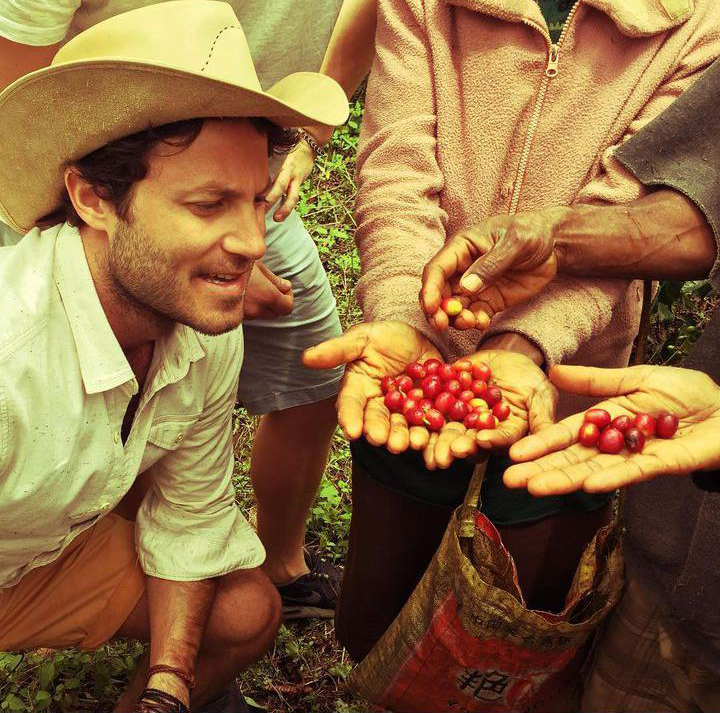
That's actually where our name came from. We couldn't figure out why everybody was talking about 100% arabica and nobody had even tried 100% robusta at specialty grade. So we set out to find, initially, just a plantation that would grow robusta the way a fine arabica is grown — high altitude, shade-grown, sun-dried, handpicked. We visited hundreds of coffee plantations and finally found what we were looking for. And the result was incredible — a very, very different product.
Twice the caffeine. Higher protein. A much thicker, richer crema when brewed as an espresso. Lower acidity. And a very different taste profile: flavours much closer to dark chocolate and walnut rather than the citrus and floral notes you get in arabica, with a lot more body. Robusta really punches through the milk when you have it as a latte or a flat white — which is how most people in the UK drink coffee. And the complexity of flavour people find in arabica often gets lost in the milk anyway. So we thought robusta was much closer to what we were trying to achieve.
But who cares what we thought? What mattered was what customers thought. Do they drink it and want more? That's the only thing that matters. Fortunately, we never looked back. We launched Robusta Revival on day one of the venture, and it still makes up more than 85% of our coffee sales today. That hasn't changed. And really, that's where our name comes from: everybody was talking about 100% arabica, we went completely against that trend, and became the de facto black sheep of the coffee industry. That's what our business is about — challenging the status quo, doing things differently. If you see everybody doing something and it doesn't make sense to you, go and do something different.
00:10:23
Conor Sheridan
People often talk about a founder's unique insight as what helps determine early product-market fit and the initial momentum in a business. You've just laid that out — the taste profiles, how people actually drink their coffee, the percentage of milk versus espresso in a flat white. How did you land on that? Was it always something you knew from how you consumed coffee, or did you have to methodically work through where the industry was and where the opportunities were?
00:11:07
Gabriel Shohet
A lot of things start from a simple question you can't find an answer to. For us, it was: why 100% arabica? Even as a kid, you'd remember the TV commercials — always 100% arabica. And you'd think, well, what's the other one? What's wrong with it?
So you start doing research. If you can't find a rational explanation for something, you want to test hypotheses and see whether others have missed something. For us, it became very obvious that robusta had a terrible reputation because of the way it was being processed. Robusta is a more robust plant — hence the name. It grows at a lower altitude on much thicker trees, which means you can harvest it mechanically rather than by hand. It has more cherries per tree, can be harvested year round, and its high caffeine content acts as a natural pesticide. All of that made robusta the species of choice for mass production of commercial-grade coffee and instant blends. The result: robusta became a commodity.
With arabica, you could differentiate by origin — a Guatemalan Geisha, a Colombian single origin — and get a price premium. With robusta, it was one price, no differentiation: a race to the bottom to produce it as cheaply as possible. The whole industry became a self-fulfilling prophecy, where all robusta production was commercial-grade, full of pesticides and mouldy beans. And rightly, people associated robusta with bad coffee.
The thesis was: can we grow robusta the way a fine arabica is grown, process it correctly, and score it at 80+ on the specialty coffee scale? Can we produce the first truly specialty-grade robusta? It was a very novel product. Most people in the world had never tried it.
00:14:11
Conor Sheridan
Moving from markets to your first brick-and-mortar site in Fitzrovia — there was a Kickstarter campaign somewhere in the middle of that journey. How much of it was genuine capital-raising versus early brand building?
00:14:41
Gabriel Shohet
The Kickstarter was 100% to raise money — because we had none. Brand building wasn't even a thought. We really, really needed cash.
And it was a proper failure, honestly. We thought: you make a video, everyone will want to give you money, and it just didn't turn out that way at all. We were sitting there calling people up, begging for cash. It was a very painful experience that gave us a bit of PTSD around crowdfunding — we've never done it again. Some people do it brilliantly and raise millions in minutes. We just weren't good at it.
We did raise around £25K in the end, which was genuinely helpful at the time. So it wasn't a complete failure — but our expectations were up here and the results were down there.
00:16:10
Conor Sheridan
There's a very well-known investor called Roelof Botha at Sequoia who always asks: what is the scale of your ambition? And your ambition, very much from day one, seems to have been where you are today — building a global business. Was that the thinking from the start, or did it compound organically over the journey?
00:16:48
Gabriel Shohet
I think so, yeah. You don't start a company because you want to be number three or number four. You start a company because you want to be number one. And that's how we've approached this venture. It's a long road and a lot of work, but it's also exciting to work towards ambitious goals.
00:17:12
Conor Sheridan
Since we've known each other and worked with Black Sheep, you've grown by close to 100% — you're growing at a rate that's not common in the industry, whether retail, hospitality, or the coffee segment specifically. You're in hypergrowth. How do you manage growth at that pace while maintaining operational stability, profitability, and the core foundations of the business?
00:17:55
Gabriel Shohet
Everything is relative. From our perspective, the last 24 months have actually been a period of consolidation. We expect growth to really start surpassing that in the years to come — we're now operating in three markets instead of one, and one of those markets is the largest in the world. If you start growing in the US, you open a lot more shops simply because of the market's size. Florida alone is roughly equivalent to the UK in terms of coffee shop sales. And that's one state. Once you add Texas, the GCC, Saudi Arabia coming next year, and more US states — that rate of growth is going to accelerate.
By UK standards, it's definitely aggressive. By global standards, there are companies opening more shops per week than we do. But for our size — 1.5 shops per week right now — it's slightly uncomfortable, which is exactly where you want to be.
When it comes to growth, there's really only one metric that matters: customer satisfaction. We track that across multiple touchpoints — Google Maps, the app, the website, delivery platforms. If that keeps going up and stays really high, we should open more shops. The moment it drops, we'd be the first to say: slow down, fix what needs fixing. Fortunately, our Google score is 4.8 across the network, up from 4.5 to 4.6 a couple of years ago. To us, that means we need to open more shops. We need to listen to the customers who want to see Black Sheep in their hometowns and their home states — and keep answering that demand.
00:20:44
Conor Sheridan
I really like that. It's quite different from a lot of the guests we've had on the show. Satisfaction and appetite for the brand are key, but people often overcomplicate it. You have a North Star metric — how happy are customers with the experience — which you can rally behind. Often we see people who think: I need all these operating metrics underneath it to be trending right before I have the confidence to open the next location. Simplifying it makes sense.
00:21:19
Gabriel Shohet
100%. And we're fortunate to be able to think about it this way. Not everyone can. If you've got a private equity fund on your cap table and they've set an arbitrary target you have to hit or get diluted, you're not going to use customer satisfaction as your sole growth indicator. We've been lucky to retain our independence, and that lets us decide: customer satisfaction, and nothing else, is what drives how many shops we open.
00:21:58
Conor Sheridan
And of the hypergrowth and maturing brands I've worked with, I've been impressed by how much you lean on data. You have a senior data analyst who's pretty pivotal to the business — which is not common. It feels like you've built the organisation in a very data-driven way, which is unusual relative to a lot of peers in the UK at least.
00:22:31
Gabriel Shohet
Data is key. We have a whole team working on it now. There's a lot of data available these days, so it's really about the quality of the data rather than the quantity. Getting clean, accurate, reliable data you can act on is 80% of the work. The infrastructure that allows you to have real-time data that's 100% reliable — that's the core of the job.
00:23:11
Conor Sheridan
Thinking about growth — and the non-traditional path again, which is a theme running through this episode — often people will prove a concept with two or three corporate stores and then franchise immediately. You did the opposite: you built a pretty large corporate estate first and leaned into franchising much later. What drove that approach?
00:23:47
Gabriel Shohet
There are two questions in there. The first is about concept development. Our approach was very much: do stuff, throw things at the wall, see what sticks, make mistakes, break things, iterate. That's not the only way. I have a good friend who started a hospitality business in the UK around the same time — more in the food space — who spent two years in dark kitchens gathering feedback from friends and family on the menu and the look and feel of the place. I thought he was never going to launch. Then he did, and it was almost perfect and almost exactly what it is today. Completely different approach, and it really worked for him. We had the opposite mentality.
The second part is about franchising. There are a lot of people now who open one location and think they can franchise it and charge people money for using their logo. It sounds attractive from a P&L perspective. We didn't think it made sense.
As you said, we had around 50 shops of our own before we started franchising. The reason: if someone is going to put their savings into your brand, you need to be absolutely sure that (a) it makes money and there's a proven track record, and (b) you're not just selling a logo — you're selling a consolidated supply chain, a suite of technology and software, readily available reporting and data, training manuals, all the things that take time to develop and require multiple locations to refine. Otherwise you're winging it and putting the onus on franchisees to figure things out while you're still figuring them out yourself.
It's important to be able to look your franchisees in the eye and say: we've been there. We know how hard it is. We had a loss-making shop and we fixed it. And here's how. We can say with confidence: if you open five or ten shops, you're going to be very close to the network average. We can show you the numbers and be completely transparent about how the concept works in the real world.
Franchising is wonderful. You meet incredible people and build great partnerships. It also allows you to focus your time and resources on supporting the network — product development, marketing, leading operations through the owner-operators. But I think it's really important to keep opening corporate shops too, so you're always facing the same challenges your franchisees face. We'll probably remain the largest operator within the network, even if we end up as a small minority of total locations.
00:28:26
Conor Sheridan
Your franchise network tends to be quite mature organisational structures in their own right — they take packs of five, ten, or fifteen, with the 20-store deal in Dallas-Fort Worth being a recent example. That seems intentional: you've sought partners who are more robust than the traditional individual or mom-and-pop franchise. What drove that approach?
00:28:53
Gabriel Shohet
We don't allow single-unit franchises. If you want to become a franchisee, you have to buy a territory with exclusivity and a development schedule requiring a minimum number of openings. That filters out the couples who always dreamed of owning a coffee shop.
The issue with a single unit is the risk. We know exactly what the network average looks like in terms of EBITDA as a percentage of sales. We know how profitable the model is, and we can pretty much guarantee that across ten shops, you'll be close to that average — slightly better if you're a great operator, slightly worse if you had bad luck with locations. But one shop? I can't guarantee anything. If you're putting your family's life savings into it, that's very high risk and not something we want to get involved in.
At the same time, we're not looking for massive groups with sixteen different brands where Black Sheep is just one of many. We want partners who are going to double down on Black Sheep — where Black Sheep becomes their main business and they genuinely care about the brand. There's a sweet spot in size, and it's not the biggest. Today we actually have more demand than we have territories, so it's really about filtering people out and picking the best partners.
00:30:58
Conor Sheridan
It feels linked to an operating principle around majority ownership — you talked about equity ownership, and the largest network operator being corporate. You can do that once you have 50, 60, 70 stores. And speaking of majority ownership as a principle — I imagine a lot of people have knocked on your door with investment offers. How have you decided to say no, and what does that path forward through franchising look like for you versus taking institutional capital?
00:31:41
Gabriel Shohet
In some ways, we've done the hardest bit. We no longer need to raise equity for the business — we're cashflow positive, and if anything we could access debt at very reasonable rates now. So the idea of selling shares and diluting doesn't hold much appeal today.
A few years ago, it was a tougher decision. Turning down large cheques from private equity and venture capital when we really needed the money wasn't easy. But we managed without it. We raised from our customers, essentially — private individuals, family offices, people who shared the same long-term vision and weren't just looking to invest and flip their shares three years later. Now that we're where we are, giving up equity at this stage would be very hard to justify.
00:32:57
Conor Sheridan
Let's move to the US. You've essentially relocated your focus — and yourselves — to the largest market in the world. You touched on Florida being roughly the same size as the UK in terms of coffee doors. Why was it important for you and Ric to make that move personally, rather than hiring a country manager or bringing someone over from the UK?
00:33:30
Gabriel Shohet
You could technically hire someone, but I'd be hard pressed to find many examples of a European company entering the US successfully that way. You really need boots on the ground. You need to understand the dynamics of that market — the size of the drinks, the drive-through model, but also the more nuanced differences in the concept, the marketing, the local adaptation. It's really important to live and breathe the market you're trying to penetrate. And I think you have a similar story — you moved to the US as well.
00:34:39
Conor Sheridan
Yes — same thing. You can't replace the urgency a founder brings to a market. You can hire great people, but that founder urgency and DNA from zero to one is irreplaceable.
00:34:39
Gabriel Shohet
Exactly.
00:34:53
Conor Sheridan
You chose the Sun Belt — Dallas and Miami were the initial markets. How did you land there rather than New York or the East Coast, where some other UK brands have gone first?
00:35:15
Gabriel Shohet
For us, it was a pretty obvious decision. We looked at a map of the US with a top-down lens and looked at key metrics — population growth, business climate — and it was just really clear that Texas and Florida were the places people were moving to, not from. That's where you want to start a business. The regulatory environment is much more conducive to business development, the fundamentals around labour costs and CapEx are strong.
And importantly: if you start in New York City and do really well there, you've only proven your model works in New York City — which is its own micro-cosmos. But if it works in Texas, Florida, Georgia, the Carolinas, the Midwest, you can say the system works in the US. We've always been a very inclusive brand that speaks to everyone — 100% of people who drink coffee, and even people who don't. We want something for everyone at Black Sheep. We didn't want to address just the top 5% of any market.
And honestly, it's also a personal decision. You're moving your family to a new place, so you want somewhere you're comfortable raising your kids.
00:37:10
Conor Sheridan
When you look at the competitive landscape in the US — the size of the coffee segment, the incumbents — did you have to change anything about the brand or how you operate, or were you able to transport it like for like?
00:37:37
Gabriel Shohet
Not so much, honestly. It's good to look over your shoulder a little bit to see what others are doing — but you don't want to be thinking about your competition all the time. You want to be thinking about what you're trying to achieve. If you're just responding to competition, you're always a step behind.
We want to be a step ahead. We do things because we think they make sense. We make mistakes — but at least we make them with conviction. We know exactly why we did something. Whereas if you just look at the competition and copy what worked for them, you might be in a different position and not doing it for the right reasons. Do things because they make sense for your business — not in relation to someone else's business.
00:38:44
Conor Sheridan
Looking back at the first 36 months in the US — what was the biggest learning or challenge from entering a new market?
00:38:57
Gabriel Shohet
There were challenges every day. The biggest thing — and it's a general statement — is that you end up dealing with issues you thought you'd never have to deal with again. You think you've grown out of it, and then you're back starting from scratch: looking for locations, speaking with landlords, being behind the counter, developing new products. It's a ton of work. But it's also really exciting — you're back in startup mode. There's a lot of good in that too. You're just a tiny bit wiser than you were a decade ago, so you avoid the most obvious mistakes.
00:40:12
Conor Sheridan
It sets the pace and the culture for the team too. They see you in it.
00:40:18
Gabriel Shohet
It's cool. You get to the new office — it's completely empty, three chairs, one monitor, the echo in the room because there's nobody there. It's a reminder of the old days in a way. But it's fun.
00:40:36
Conor Sheridan
It resonates. We opened an office in New York in January — initially just me and my chief of staff. A makeshift poster of Nory on the wall. Do you buy a gong or do you hire people first? You're just trying to create a base. As they say in hospitality — you can't build an atmosphere in an empty restaurant.
00:40:36
Gabriel Shohet
And you can't build culture when there's no one in the office.
00:41:06
Conor Sheridan
Exactly. You've talked before about competing on five dimensions simultaneously — an orchestra of product quality, speed of service, customer experience, technology, and vibe. In practice — whether it's franchising or new market entry — which of those is the hardest to execute consistently, or hardest to retain?
00:41:35
Gabriel Shohet
Every market is different. Even within a single market, different geographies behave differently. Hiring in London is very different from hiring in the north of Scotland or in the UAE. The UAE has an incredible tradition of hospitality — in some ways it's easier and in some ways harder. You have to identify where things are easier and better and focus on those, and adapt where you need to. Working with great local partners who have deep knowledge of their market helps enormously.
00:42:26
Conor Sheridan
Moving to what's next. You're at one and a half locations a week and feel like this might be the start of a J-curve in growth. There was also some talk recently around a potential US listing. Is that something you're running towards?
00:42:52
Gabriel Shohet
I don't know where that rumour came from — we've never had any plan to do that. Not opposed to the idea in principle, but we're not pursuing it. I think it's good to have long-term goals, but what really matters is the next year, two, three years. Beyond that, you're so far into the future that it's subject to so many changes. Again, we're looking at growth through the lens of customer satisfaction — that's really the only thing that drives how many shops we open in any given year.
00:43:31
Conor Sheridan
And finally, before we move to the rapid-fire section: the theme of this episode has been the counterintuitive approach — in quality, execution, branding, data. When do you become the incumbent? And how do you avoid that perception of being the chain versus the challenger?
00:43:59
Gabriel Shohet
Philosophically, what makes you the incumbent? What makes you a chain? "Independent" gets thrown around a lot in the coffee shop industry — people say "small, independent" as if those words go hand in hand. The reality is you can be independent and very large — it depends on the ownership structure and whether the founders still have control. And you can be tiny but PE-backed and not be that independent at all. So it's quite relative.
That said, the number of shops isn't subjective — at some point you're objectively a large company. So you want to make sure you're the best large company out there. The best chain, if that's what you are.
Different markets are very chain-friendly — the UK, the US, the Gulf countries, Japan, South Korea — where people genuinely appreciate a great chain and the consistency of taste and experience it offers. Other markets, not so much. Italy, France, parts of South Africa and Australia — in those places "chain" is synonymous with poor quality in many people's minds. It's very cultural. And it's important to be aware of those different interpretations as you enter new markets.
00:45:58
Conor Sheridan
So we might see Black Sheep in South Korea before Milan, then — potentially?
00:45:58
Gabriel Shohet
Never say never.
00:46:05
Conor Sheridan
Let's move to the quick-fire round. What's one thing Black Sheep does operationally that your competitors would steal tomorrow if they could?
00:46:23
Gabriel Shohet
That's a great question. The beauty of retail is that our competitors could literally copy anything we do today — tomorrow, if they wanted to. We don't have a patent on our Norwegian waffles or our use of robusta coffee. That's the beauty of it: it's not about great ideas. It's about the execution of them and the customer experience you create.
We're not cagey about what we do. If someone copies something we're doing just because we're doing it, it probably won't work anyway — because they're doing it for the wrong reasons.
When we launched matcha, for example — much earlier than most coffee shops did — we sourced ceremonial-grade matcha from Japan. Today 18% of our sales include a matcha component. That's not the case for brands that came later and bought commercial-grade matcha from China. One major incumbent was recently bragging that matcha had hit 5% of their sales. For us, that would be close to a failure — if you launch a hero product range, it should be making up a much larger percentage of sales.
There are no deep secrets in retail. Even our Norwegian waffle dough — we spent a lot of time developing it and it's really good. But at the end of the day, a waffle is a waffle and you can probably imitate it. What makes it a success or failure is whether it makes sense for your concept and your brand, and the conviction behind why you do it.
00:49:12
Conor Sheridan
What's the most important metric in a coffee shop that most operators don't track?
00:49:19
Gabriel Shohet
I'll be honest — I don't know what people typically track. I can tell you what matters to us. Customer satisfaction is the single most important metric, as we've said. Beyond that, all the usual suspects: like-for-like sales growth, and so on.
But I don't think you can summarise a business with a couple of metrics. The emotions people feel when they walk into your shops — that's hard to measure, but in some ways more important. Data is great and you should keep track of it and make sense of it. But it's a means to an end. The goal isn't to hit great like-for-like sales growth or low wastage — it's just a baby step towards building something much bigger and more wholesome.
00:50:21
Conor Sheridan
If you could open next door to any brand in the world today, who would it be and why?
00:50:29
Gabriel Shohet
In the UK you often open next door to other brands anyway — that's just the nature of the beast. In the US, sometimes you're erecting the building from scratch in the middle of nowhere with a drive-through, and there's nobody around.
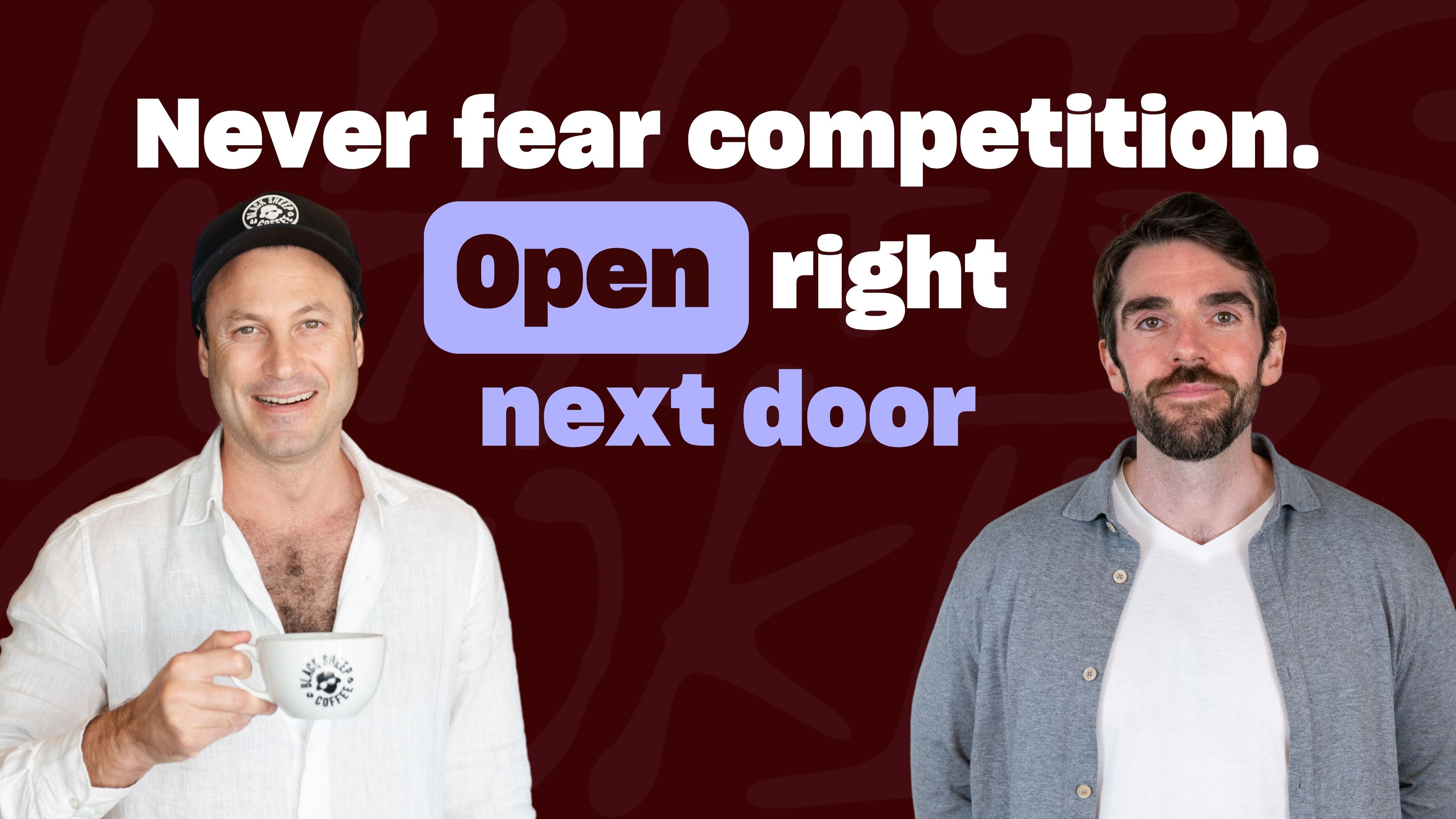
One of our company slogans is: never fear competition — open right next door instead. If we see a large incumbent doing really well somewhere, we're not afraid to open next door and compete for their customers directly.
I hear it all the time from real estate brokers: "great location — there's nobody else selling coffee nearby, you're going to do really well." And I think to myself: that's the complete opposite of how we think. If there's a coffee shop doing really well there — great, we'll open next door and compete head to head. You have to win the hearts and minds of the people in that area.
00:52:07
Conor Sheridan
What's the biggest mistake you see challenger brands make when they come up against incumbents?
00:52:24
Gabriel Shohet
Everybody loves a great David and Goliath story. Everybody loves the narrative of the small brand that doesn't do traditional marketing, finds a clever niche, and beats the giant with a clever slingshot. And I think that's a big fallacy.
In business, you need to assume Goliath also has a slingshot and is also clever. If you're David, you need to go to the gym, start working out, become stronger, and eventually compete head to head — playing by the same rules, at the same game.
The common error is thinking: I'm small, but I'm clever — that's how I'll win. And you end up fighting a different battle from the one you actually need to win. The real answer is boring: you need to work really, really hard, be very disciplined, and accept that it takes time. Even with maximum effort, if you start a coffee company tomorrow and want to get to a thousand shops, you can't do it in six months. The laws of physics apply.
I had someone come up to me recently who'd started a gum company. His pitch was: we don't use plastic in our gum. That's what makes us different. I tried the gum — it didn't taste good, stuck to your teeth, went mushy after a minute. It just didn't work as a gum. It's so much easier to think: all I need is to surf the plastic-free wave and someone will acquire me.
The harder thing to do is to say: I'm going to make a regular gum, but it's going to be better, the brand is going to be great, the marketing is going to be excellent, and it's going to take me years to take down Trident. But not many people want to do that. Because it's really hard, and the chances of success are genuinely small.
If you want to build a proper business, you need to look at the incumbents, look at the really big players, and think: I'm going to do exactly that — but better. Better product, better service, better experience, better technology, better marketing. Not many people want to hear that.
00:57:15
Conor Sheridan
That's great advice. Ideas are cheap — unique insights to start a business, maybe a million people have them. The execution, compounded every year for a decade, is the hard thing you have to show up and do every day.
00:57:38
Gabriel Shohet
Everybody knows that's the truth. You don't want to have a podcast episode about it because it's boring. Everybody wants to be David.
00:57:50
Conor Sheridan
Yeah. Last one. You're at 135 shops, growing at one and a half locations a week. Where is Black Sheep Coffee in ten years?
00:58:03
Gabriel Shohet
I have no idea. Ten years to me is a lifetime. We don't even have a business plan that goes ten years out — and for good reason. In the very early days we made one, and I looked at it recently just for fun. It was completely arbitrary — a finger in the air. So we'll see.
What I can say is we'll continue to abide by our values and mission: source the best beans in the world, hire the best baristas in town, never fear competition — open right next door instead. If we do that well, we should end up with a lot of shops. But that's a byproduct of doing it right. It's not the goal per se.
00:59:12
Conor Sheridan
Whatever it looks like, it's going to be incredible if it keeps compounding at the same rate. Congratulations on everything so far, and thanks so much for joining. Really great to have you on — some serious operational nuggets and honest advice in there that a lot of founders can take away from.
00:59:31
Gabriel Shohet
Hopefully it's helpful. But honestly — if you're starting a business today, don't take too much advice either. There are so many people out there giving advice, and sometimes it's better to just go out, do the thing, and ignore a bit of it.
00:59:58
Conor Sheridan
Yeah, 100%. Gabriel, thanks so much for joining us. Awesome to have you on. Have a great day.
00:59:58
Gabriel Shohet
Pleasure. Good to see you.
01:00:06
Conor Sheridan
A few things really stayed with me from that conversation with Gabriel.
First, the founding conviction. Black Sheep Coffee was not built on a spreadsheet market gap analysis. It was built on a genuine belief that robusta beans — when done properly — are better for espresso-based drinks than the industry was willing to admit. That conviction was so contrary to received wisdom that the brand effectively named itself after being the odd one out. And it's not just the founding story — it's the operating principle that runs through every major decision since. The bean, the store locations, the approach to financing, the US market entry, the franchise model: all of it traces back to the same willingness to be wrong in a direction that no one else had bothered to test.
Second, the location strategy. "Never fear competition — open right next door instead" sounds like a slogan until you realise they actually do it systematically. And it works because it forces you to compete on fundamentals, on merit, in the highest-footfall locations in the world — rather than finding softer ground. Most operators default to white spaces. Black Sheep defaults to the fight. That's the kind of confidence in the product, the team, and the experience that tells you something important about how they think about the customer: they don't need to protect them from the competition. They just need to be better.
Third, the franchise architecture. Remaining majority founder-owned at 135-plus locations is genuinely unusual. It means every strategic call — who to take as a franchisee, which markets to enter, whether to take external capital and on what terms — stays in-house. That's a competitive advantage that's hard to quantify but easy to see in the outputs. When you're not optimising for a board's exit timeline, you can afford to be patient about partner selection and market sequencing in a way that PE-backed businesses typically can't.
Fourth, the US move. Gabriel and Ric relocating to America isn't a press release — it's a strategic signal. The Sun Belt entry with Texas first is a deliberate choice to prove the model in markets where franchising compounds. More successful territories create density and proof of concept for the next, and the next. That's how you get from six US locations to a 20-store development deal in less than 18 months.
And finally, what this means for anyone running a hospitality brand right now. The lesson isn't to be contrarian for its own sake. The lesson is: if you have a genuine, defensible product belief and the industry consensus tells you you're wrong — stress-test that belief harder, don't abandon it faster.
If you're building a challenger brand, thinking about a franchise model, or trying to figure out how to compete against a better-resourced incumbent, this conversation has the playbook and the honest advice you need to hear.
Thanks for listening. If you found this useful, share it with someone who needs to hear it. See you next time.
.png)