00:00:00
Matt Rodbard
You can still open in New York. So I hope that's a headline from it. You can still actually open a restaurant here. Some operators move and they're just so focused on opening and doing, getting the menu right and the concept right, that they don't think about the community. Especially the hotshots who maybe have great press and really have extraordinary food, they fail because they don't ingratiate themselves with the community.
00:00:24
Conor Sheridan
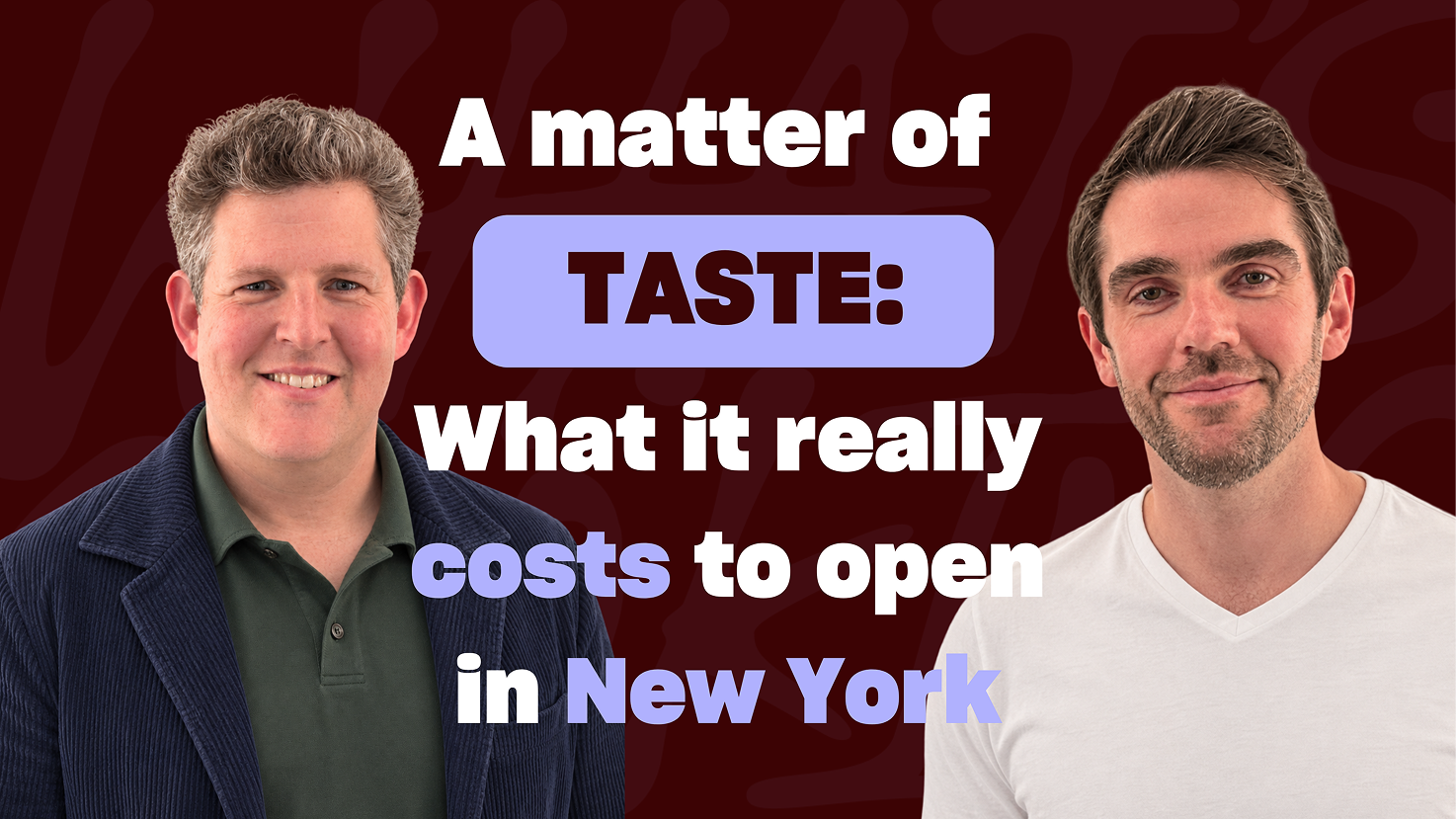
I'm Conor Sheridan, and this is What's Cooking, the show for operators running hospitality businesses at scale. Every guest we have had on this show runs restaurants, sites, a payroll, a profit and loss account, and a read on the industry shaped by the particular rooms that they are responsible for. Today is deliberately different.
Opening a restaurant in New York now costs something like three times what it costs in any other American city. A number that large does more than make life difficult. It decides who's allowed to try at all, when the only groups who can get a door open are the ones with serious backing behind them. The range of what opens gets narrower, and the operator with one strong site and no outside money has a much harder route to the second site than they had ten years ago.
That is a story about a market. My guest today covers the American food world for a living. He is the founding editor-in-chief of Taste, which he launched with Crown at Penguin Random House, and which has won two James Beard Journalism Awards. His podcast, This Is Taste, is past its 100th episode. Three books, including Koreatown and Korea World, and reporting for The New York Times, Wall Street Journal and GQ.
That is Matt Rodbard, and he talks to people in every one of these cities every week. That's a vantage point none of us have from inside our own business. That's why I wanted him to join me on this podcast.
00:01:50
Conor Sheridan
Welcome to What's Cooking. Great to have you on the show.
00:01:52
Matt Rodbard
It's great to be here. I'm excited to talk about your new hometown.
00:01:57
Conor Sheridan
Yeah, 100%. It's fair to say, a first episode filmed from New York after making the move over from London. So it's a privilege to have you on as a first guest, and I couldn't have asked for a better first guest.
00:02:07
Matt Rodbard
I'm excited to talk to you about what you think. Fresh eyes on the scene. Are you living in Williamsburg now?
00:02:13
Conor Sheridan
Yeah, it's definitely a change from London. It's amazing, right? So much energy in the city. But Manhattan, where we are now, and Brooklyn as well, the food scene is incredible. I think we were just saying off camera, it gives independent vibes, which is cool, right?
I think New York, which we're going to get to, is known to be an expensive city to operate in, CapEx and OpEx wise. So it's definitely cool to see the vibe prevailing in the borough, in terms of a lot of independents spinning up, great concepts. I mean, you can
00:02:45
Matt Rodbard
Definitely ball on a budget here, too. I know we're going to talk about costs, and they're rising everywhere. But you can still open in New York. So I hope that's a headline from it. You can still actually open a restaurant
00:02:59
Conor Sheridan
here. And there's a lot of creativity, right? We actually hosted an operator dinner recently with a bunch of folks, some who have a couple of hundred outlets or locations, some with one or two, and the formats are changing. You see new operators do a lot with smaller formats, a bit more creative ways of operating.
So that's definitely cool. But we got straight into it. Before we get into it here, it'd be cool for those listening to hear a little bit about your background and a bit on Taste.
00:03:25
Matt Rodbard
Absolutely. I started the podcast This Is Taste about eight years ago. So I spent a lot of time doing what you're doing right now, talking to chefs and cookbook authors and journalists about the food world, and we publish a few episodes a week. But I also run Taste, which is an online food publication.
We turn ten next year.
00:03:45
Conor Sheridan
Congratulations.
00:03:46
Matt Rodbard
Thanks, buddy. Yeah, we've had a great run with reported stories, and we've won a couple, three, James Beard Awards. So over the course of the time, we've been honored by our peers for some of our reporting, and we're at a cool inflection point for food media right now.
I think it's really exciting. I know there's been a lot of closures and changes happening, and that's been not as exciting. But for the folks who are still around right now, there are some exciting things happening in the way we cover not just restaurants and chefs, but grocery and CPG and all sorts of things.
00:04:21
Conor Sheridan
Yeah. Content and media have never been more important than in the restaurant game, right? If you can nail that, it feels like you're giving yourself such an accelerant to be successful.
00:04:29
Matt Rodbard
Yeah, absolutely. I think having a really strong sense of the media, and a media strategy as an operator, is important. It can be from a PR agency and being professionally honed, or it can just be you and your TikTok and doing something authentic and cool, but you have to play in that sandbox. Long gone are the days when a chef can just be a chef, head down, doing service.
And that's it. No way, that does not work today.
00:04:56
Conor Sheridan
How do you see people doing it right? Do you see anyone in terms of that approach? You've touched on a couple of mediums, pure TikTok. How do you see people bringing that strategy together, or any examples?
00:05:07
Matt Rodbard
I think with social media there are lots of ways to do it, right. You can do reels, you can do video, you can put up your specials. I was looking at E. Cavallini's Instagram account. It's a great restaurant in Brooklyn, Nick Kurtulus is the chef. And Nick, they don't post a lot, but they post the most important information, like menus and specials.
And once in a while Nick will do a day in the life of a chef, put a camera on, like a GoPro, and do a time lapse of him cooking. So I think that's really clever, and that's a low-frequency type of social media plan. And I think the guys like Jeremiah and Fabian, those guys are amazing. They are always on social, doing cool things and presenting their work. And then there are restaurants and chefs who are in podcast world. I think David Chang's the best example. While he is obviously in every day at his restaurants, he still is a chef and an operator, he still has plenty of restaurants, and he is a media company based around podcast and video.
And so I think there are different flavors of media for chefs and operators to play in. But you have to do something. You can't ignore it.
00:06:20
Conor Sheridan
Stay front of mind. Yeah, 100%. I asked a question to the team in the office, and one of them was just scrolling through TikTok to find where they wanted to go for dinner. Oh, interesting. And I'll probably show my age a bit, and I was like, what are you doing? It's like, this is how I find my restaurants.
Yeah, I only go to TikTok to find them.
00:06:37
Matt Rodbard
TikTok for restaurant discovery. Interesting. So that is an
00:06:40
Conor Sheridan
energy, right?
00:06:41
Matt Rodbard
Yeah, that is an energy. I was going to say, Beli, if you're Gen Z, you're going there, which is also an energy. Listen, I love that these TikTok creators are showing the world of food in unique ways and telling great stories. And I personally wouldn't make my recs via TikTok, but hey, man, if the dish looks great and you're hungry, go find it.
Go there.
00:07:04
Conor Sheridan
Yeah, I'm an advocate for that. So we're here to talk a bit more holistically about New York and operating in New York, long known as the best restaurant city in the world.
00:07:14
Matt Rodbard
Oh.
00:07:15
Conor Sheridan
Yeah. Big claim, right? I think there's maybe a bit of rivalry between London, where I just came from, and New York. We were talking about it off camera. Potentially London's lower cost of entry means you're seeing a lot of interesting concepts, or maybe more, open up because the cost to play is a little bit lower.
But how do you think about New York's status as the restaurant city in the world? Is it under threat? Is it still number one?
00:07:38
Matt Rodbard
Well, great topic. We can go all day on this. I think in America, the best food city is Los Angeles by far, in terms of diversity of cuisine and really cool neighborhoods that have really concentrated five or six restaurants, like maybe the South Bay might be Oaxacan cuisine. It might be Koreatown, it might be Little Japan. But definitely New York is the best restaurant city in America. The world, I haven't been to every city, so I don't know. But I think we as New Yorkers understand some of the major tenets of hospitality and restaurants.
So, great cuisine, great space that has mood and vibe, and, of course, service that makes sense. I think we're very impatient when service does not make sense, as New Yorkers, and restaurant operators will be told that very quickly by New Yorkers.
We have history, too. Obviously a lot of history has gone away in the past decade, so that's one thing that we don't have anymore. Plenty of classic places have gone away. But we have, where pizza was basically invented. We have an incredible Chinatown, in three boroughs. We have Koreatown. And we have some old-school places that are one of ones in the world. But then you look at places like London, and in terms of creativity, because of operating costs, there's more creativity happening in London.
It's obvious. You look at menus in New York and you're seeing a seared fish in a herby sauce. You're seeing steak, steak for one, steak for two. You're seeing a lot of the same things. Whole fish perhaps, depending on the cuisine, and of course, chicken. You're seeing lots of roast chicken. So there's just a lot of uniformity with the menu structures in New York that you're probably not seeing as much in London.
00:09:40
Conor Sheridan
Interesting. Do you think that is solely down to the price of entry? I think we were talking outside about the OpEx, the cost to operate in New York, anecdotally versus London, versus elsewhere in the US. Does that mean that the risk is so high,
00:10:01
Conor Sheridan
the risk of failure is so high financially, that you need to move a little bit more to the middle in terms of uniformity?
00:10:07
Matt Rodbard
100%. I think New York is not the only city. I mean, San Francisco, OpEx costs are massive as well, and that's mostly because of real estate. We're over $100 per square foot here in Manhattan, and it's really different from a lot of other cities. So you've got that real estate cost.
Labor costs are higher here, $70 in wage, plus you've got taxes here, payroll taxes that you can't ignore. And in parts of Europe and around the world, you don't have quite the payroll tax structure. But I think it is required that you put butts in seats and you sell food.
Right. So you have to do crowd-pleasers. A lot of chefs find pressure to do certain crowd-pleasers, and you know, to very good results. Crowd-pleasers work extremely well, and you're going to get people coming back for those, like the steaks and the proteins and the pastas for 40, 42, and what you have to charge, and sometimes it works.
But in terms of creativity, maybe broadly, it's not as creative as other cities.
00:11:18
Conor Sheridan
Interesting. I'm originally from Dublin in Ireland. You have a bunch of restaurants there operating, and the cost per square foot for us still today is maybe $60. So you're talking 40% cheaper. Obviously the density of folks in Manhattan, right.
00:11:36
Matt Rodbard
And then to come.
00:11:37
Conor Sheridan
For sure. And the structural advantages of that, having it as, say, sub 70% of your P&L, gives you more breathing room to take bets on different locations. Right. But what I'm seeing, you asked about my experience here, is definitely a lot more creativity here in smaller spaces.
And maybe that's the cost per square foot. And maybe that's tiny spaces that are
00:12:04
Matt Rodbard
only existing because people can afford them.
00:12:05
Conor Sheridan
Yeah. But they're turning out some amazing food and amazing concepts, and views around the block. But yes, they're doing interesting stuff.
00:12:13
Matt Rodbard
So you've been to Haystack yet? Obviously it feels like you're explaining one of our better restaurants. You're saying it's a tiny little space, and they have a house bistro which is three times the size, but they're doing brilliant work in a small space.
Yeah, you see that a lot in New York.
00:12:28
Conor Sheridan
Sometimes when you have these constraints structurally, it just forces creativity of a whole new, different type. Right. I think even if you go back to the example of Dublin, pub culture used to be the big thing. People would go and buy and open bars, and then they became priced out, because of the figures to open a bar, and the next generation couldn't afford that.
So then cafe culture and small entrepreneurs went smaller, and every horse box in Harlem was a shop. So you tend to find some creativity. Yeah, totally. And so you touched on some of the other markets. Are there any cities or any states doing it differently in the US today, that you're seeing folks maybe migrate to, opening new restaurant concepts?
So if New York is expensive, what's your answer to that?
00:13:13
Matt Rodbard
I just had an amazing meal in Chicago at a restaurant called Feld, which I really love, and it was a tasting menu. They won the James Beard Award, so they're really well regarded now. But they're operating on the Near North Side. It's not in the Loop or a high-rent neighborhood.
And I think what they're doing is an example of, in Chicago, you can get a black box with a little backyard and pay a tenth of what you'd pay even in Brooklyn and do an extraordinary tasting menu. So I think Chicago is cool right now. I've been back a couple of times this year, and I think that is a city where they love restaurants. They have a really well-paying, supportive community there. And it gets forgotten sometimes, because of the weather, it can be challenging for some people to move there. But there are just great restaurants in Chicago. Off the top of my head, that's one city. I think Phoenix, Arizona, I've heard it has some really interesting opportunities there.
You've got, obviously, a lot of snowbirds coming down in the winter, an older population. But I think there are some real movements happening within the younger generation in Phoenix. I didn't think I was going to talk about Phoenix today, and actually, this is totally unexpected.
00:14:31
Conor Sheridan
I mean, for New York operators listening, if they're looking at expanding into Phoenix or Chicago, what do they need to be cognizant of when bringing concepts from city to city?
00:14:43
Matt Rodbard
Certainly know your market. You can't just pop up in a city and expect people to come because of your press in New York. That's certainly not going to happen. Another city that comes to mind, actually better than Phoenix, is, I live in the Hudson Valley now, the lower Hudson Valley, and there's the city of Kingston.
It's about a two-hour drive from New York City. And that's a really interesting city for a lot of people to look at. There's definitely a community there that supports the new restaurants. And I think a lot of people from the city are moving up there full time or part time, and understanding that there's a real culture and community that goes back 50 years, 100 years in Kingston, and then, of course, all these new people too.
So I think, when moving up from New York to Kingston, hypothetically, you obviously need to get to know the community. It's so important. You have to not just go to the community board, but understand where the nearest school is, even if it's not a concept that appeals to children.
Just know where the school is, and know the annual community events, they happen all the time. And I think some operators move and they're just so focused on opening and getting the menu right and the concept right that they don't think about the community. Especially the hotshots who maybe have great press and really have extraordinary food, they fail because they don't ingratiate themselves with the community.
00:16:13
Conor Sheridan
It's interesting, right. And do you see that as a way to generate more reach, for people to feel like you're putting roots down and you want to be part of the area, or do you have any tactical advice?
00:16:28
Matt Rodbard
If you're known as a standoffish big-city chef coming into a smaller town, even if it's going from near Chicago, people talk, there's gossip. You want to be known as someone who's very open to the community. No one wants a big-city chef coming in and being close-minded about the people you're going to serve.
So I think it's a little bit of that happening. Also, when you're moving from city to city, it's, what have you learned from your work that you can bring to this new city that will excite the community there? So if there's nostalgia from New York, and you're bringing a New York shop to Los Angeles, for example, bring a little bit of that New York attitude and use it as a strength.
00:17:18
Conor Sheridan
Yeah, that's great advice. Rolling back to New York, you said previously that maybe five or ten years ago, it was a hard city to penetrate as an international concept, or maybe a chef-driven concept from London. But now it's becoming maybe a little bit softer to enter, or the market's more receptive.
You've seen concepts like Hawksmoor or Gymkhana land in from London specifically and do pretty well. What's driving that?
00:17:46
Matt Rodbard
I was going to use those examples too. Hawksmoor is a great example of an import that just took off in Brooklyn, and it just did so well. And I think that was just getting your operations really in check and understanding the market and doing some of the things I previously said, which was, know your market, get to know the community.
So Ambassadors Clubhouse, that's the hot place right now. And I think there's a mystique around it. And I think when you're coming from overseas, or even moving from LA to New York, which has been really challenging in the past, now the brand equity of some of these places is so strong that you can't deny it in certain cities.
I mean, Carbone is a great example. They are great operators too. I went to Carbone in Las Vegas last year and it was really good. It was probably better than the Carbone here in many ways. So you have to nail the simple stuff, make sure the food is really good and your service is really trained.
But I think the younger generation is, perhaps, this is a pet theory, a little more open-minded to brands coming in, as opposed to maybe 20 years ago, when there was a lot of, the out-of-town chef is not welcome here.
00:19:01
Conor Sheridan
Okay, makes sense. And for someone like yourself, for these brands, you must be a first port of call, right? We talked about content, pure. They have to get in front of the people who know the food scene, listening to your podcast, doing your stuff. Do you see a lot of international brands looking to engage in a content strategy with you, or reach out to you and your team, or people like yourself?
00:19:22
Matt Rodbard
Absolutely. We get pitched a lot, my inbox is crazy with people wanting to come to the show, and it's super flattering. So we definitely get chefs from overseas who want to make a statement in the States and come on our show. And sometimes they're thinking about new concepts. Sometimes they're just on book tour, but they definitely need to get in touch with the local media.
Right. And understand. And that's why you hire an agency, perhaps. And there's a lot of value in hiring a media agency. It's not for every operator to have to carry that retainer or fee through a year or more, because the media has changed so much, the ROI is hard to figure out these days with so few media outlets.
But thinking about social strategy, too, of course, and agencies can help with that. But yeah, we get engaged all the time by out-of-town chefs.
00:20:13
Conor Sheridan
And beyond the podcast, you mentioned some book writing, and you have to mention that, New York Times bestselling books as well, right.
00:20:22
Matt Rodbard
Thanks for mentioning that.
00:20:24
Conor Sheridan
I appreciate that. And you have a lot of expertise to get to this next point. A lot of concepts produce their own books, their own chef-driven books, recipe books, cooking lifestyle. How do you think about that as a strategy for brand building and building advocacy? Do you think it's a good strategy?
Any examples of when it's done well? You don't need to give examples, but maybe.
00:20:49
Matt Rodbard
Taste is part of Penguin Random House, so I work in book publishing, so I'm very qualified to answer this. And I think where I work tends to be best in class. I work closely with those imprints and a long history of publishing restaurant cookbooks, particularly at Ten Speed Press.
I think of books like Momofuku, Pok Pok, these books, Jerusalem, you know, we published all those books. And I think not every restaurant should have a cookbook. But if you engage with an agent, and the agent believes in your story, that is your first step, typically.
And if that agent believes that you have an ability to tell a story and perhaps sell books, it is so worthwhile. It is like, so many of you use the term, the most expensive business card you'll ever produce. But that's so true. Have you heard that before?
00:21:51
Conor Sheridan
Yeah. What happens?
00:21:52
Matt Rodbard
Yeah. That's definitely what a lot of people will say, because the economics of restaurant cookbooks, you're putting a lot of your energy into the actual book. And we're all hoping that it sells, and some sell really well and some sell more modestly, but they still sell and they get into the homes of people.
And the cookbook industry is interesting. It's not strictly an object that you're going to cook from. A cookbook can be many things. It can be in a kitchen. It can be on a nightstand. It can be on your coffee table. And buyers, we're selling cookbooks, they're doing well, people love cookbooks. And for a lot of reasons. With a restaurant book, you have the opportunity to really think about your story, particularly if you're a restaurant group that's been around for some time and wants to tell that heritage, or if you're a chef at a restaurant and you have a really great sense of recipe development and concept.
There are great ways that you can be the chef at the restaurant, but it can be more of a lifestyle book. There are ways to do that. But I think the process is tough. It's not an easy process. It's multi-year, a lot of work. A lot of restaurants and a lot of chefs, in the end, they get the book sent to them, and they look at it, like, wow, I did that. And it's a lot of pride. We know chefs have a ton of pride in their work day to day in the kitchen. And when you have a book, it's an extension of that.
00:23:21
Conor Sheridan
Yeah. Nice. It's very cool. It can definitely be used by folks as a formula to produce great food for their families, but it's also a representation of their personalities, their life, their own personal aesthetic, some of the ways you can resonate with people.
I even know on my coffee table, there's lots of books. I think I fail at every recipe, but they look cool, right?
00:23:44
Matt Rodbard
They look cool. They're well written, they tell a story. And also, when you put out a book, there's ultimately going to be a media cycle around the book, and you're going to be able to go on tour, perhaps, and do some events with your friends in the industry. And it's just a great way to get into the media cycle and talk about your restaurant in a cool way.
00:24:04
Conor Sheridan
Yeah, that's very cool. Coming back to New York a little bit, if you look forward from now, what changes would you hope to see to keep the progress in the city going, from a food and beverage point of view? If a couple of years down the line, what do you think we need to see to maintain the vigor and the vitality of the concepts?
00:24:24
Matt Rodbard
We need to fix our payroll tax. Explicitly, I'll say, it's too high, it's unfair, and operators are struggling to make rent with this tax in place. And I think one solution, and Camilla Marcus is presenting this, it's her idea and I'll paraphrase it, is you take two thirds of that payroll tax you pay every month and give it back to the restaurant.
Don't give it back to the operator. It's not going to be profit. But let them do something with that payroll tax, like let them invest and use that savings towards PTO and benefits for their staff. Let them reinvest it. Because we know restaurants are people-intensive. You need a lot of people to operate a restaurant in that same 2,500-square-foot space.
Think about that. The staff at a restaurant and the staff next door at a watch store or at a Verizon store, you can have 75 employees in one and four employees in the other. You're paying the same rate of payroll tax, or you're paying much less, obviously, with fewer employees.
So I think the cities need to realize that payroll tax is detrimental to restaurants' growth. And we need restaurants to be open in communities. We need these restaurants to be operating in neighborhoods that, without a restaurant there, or cafe or bar, etc., are dead at night.
And that's a public safety issue. You need street traffic, you need foot traffic, you need operating restaurants. It keeps neighborhoods safe. And so there's a lot of civic obligation, I would say, from governments to help restaurants survive, and pretty simple ways to adjust the tax structure.
So that's one example that I think, in five years in your city, I would hope that there's been some adjustments. Who knows if it'll happen, though.
00:26:29
Conor Sheridan
Well said. And I'll vote for you if you're running, right. I mean, this is
00:26:34
Matt Rodbard
This is, I would say, check out Camilla Marcus's work, and many chefs and operators who really dedicate a lot of time to changing tax policy.
00:26:46
Conor Sheridan
Oh, it's really smart. It's really well put. I think you're also talking outside, you talked about a civic responsibility for safety in neighborhoods and the diffusion of life, careers and jobs. But equally, we were talking about the next generation of kids growing up, there's a chance of a loneliness epidemic if they are stuck doom scrolling because there's nowhere to go in real life and hang and have a coffee, or get a slice of pizza, or just sit around.
So yeah, I think there are a lot of reasons that you need some intervention to make sure that doesn't become the case.
00:27:17
Matt Rodbard
I like that point you brought up, Conor. I think it's super on point. We are in the middle of a loneliness epidemic. I think that people are glued to their phones, myself included, I take full responsibility for that, too. And at some point, doctors are going to say, you have to leave your phone at home and go to a restaurant, or go to a cafe, go to a live comedy show, and not be on your phone.
It's just for public health. And this is a great reason why we need these third spaces to be open in communities. We all love restaurants for many different reasons. But I think one reason we all really love restaurants is that it's a place where we see people interacting, bumping up against each other, celebrating, maybe just having a boring salad, rice bowl, but still you're interacting with humans, as opposed to people who are working from home remotely, getting that seamless order, and not talking to anyone for the day.
That can't be good.
00:28:18
Conor Sheridan
No, it's not. Yeah. We're going to move on to the next segment, which is the quickfire.
00:28:24
Matt Rodbard
Oh, I love it.
00:28:24
Conor Sheridan
I mean
00:28:25
Matt Rodbard
I'm ready for it.
00:28:26
Conor Sheridan
I'm ready for it. So, rapid-fire questions. First one up: New York, Los Angeles, or London? Where would you open your restaurant right now?
00:28:35
Matt Rodbard
I would say 100% Los Angeles. I think the media is thriving there. I think there is a great opportunity in neighborhoods to bring cool concepts to the Angelenos who maybe are underserved. I think it's a very, very cool city. I think they have similar problems with the New York City tax structure, and it's very expensive to operate.
I have to take that into account. London's a close second. As I mentioned before, creativity is at its highest there. And New York came in third. You've got to really have some stones to open in New York State.
00:29:13
Conor Sheridan
Yeah, for sure. What are your top tips for finding new restaurants to eat in when you're visiting a new city?
00:29:20
Matt Rodbard
I have to go back and say, journalists are doing their job, and it's reading local writers, be it at the local paper, or a great Substack, or a podcast, or people who are actually writing about the food. You notice I'm excluding influencers and TikTok folks and creators. I love them, and I think you can find great food through them.
But going back to, if it's Washington, DC, or the Washington Post, look at their top 40 restaurants and just read that. Those are the people that I go to first. And then I just walk around. If you come from a city and you understand restaurants, and your audience understands restaurants, you have an instinct, and there's just a really great opportunity for serendipity.
It doesn't have to be the best meal you're ever going to have. But it's really fun to walk around a neighborhood and just find a place and try it out.
00:30:17
Conor Sheridan
Yeah, they often feel the best, right? Because there's no expectation, there's no preconceived notion. And you just hit the spot, and it
00:30:23
Matt Rodbard
hits the spot sometimes. And you can tell if it's full, and the menu looks cool, and you like the vibe, and the wine list looks cool, you look in the window, the menu, it's just, go check it out.
00:30:37
Conor Sheridan
Yeah. Great advice. Anyway, last thing you should do that.
00:30:40
Matt Rodbard
Copenhagen is the best place to do that. I feel like Copenhagen, you just walk around and find some cool spots there.
00:30:45
Conor Sheridan
Yeah. Well known, well revered for its food quality, right?
00:30:47
Matt Rodbard
Absolutely. It's a great city.
00:30:49
Conor Sheridan
What did you believe about this industry five years ago that you don't believe today?
00:30:54
Matt Rodbard
So I would say five years ago, I thought that influencers, while entertaining, would still be
00:31:06
Matt Rodbard
maybe second-class citizens in the ranking of what mattered to put butts in the seats. Five years ago, this is, where are we, 2021, it's pandemic. So I would say 5 or 7 years ago, maybe 2019. I'm like, yes, creators, they're really fun. But I'm still like, the New York Times review, the Los Angeles Times review, The Infatuation, the journalists doing the job, those would be the most important voices. It's flipped. Obviously. And we were talking about that before. Influencers have so much importance now, and they really do put butts in the seats. And people really do follow TikTok to get that dining recommendation.
I definitely wouldn't have predicted that five years ago.
00:31:50
Conor Sheridan
Yeah. Same. I think in 2021 there was even, not pushback, but there was some chatter around representing things as ads or not being ads, and when was it a recommendation versus an advertisement, and it was getting a bit of noise, but now it seems to have blown past that, right?
00:32:09
Matt Rodbard
I think now the audiences are more discerning about who they follow and who they trust. And there are many, many creators, meaning they don't work for a publication, who have used journalistic integrity and standards, and never pay for, or never take, free meals, and pay their way, because they see the value.
Especially if they're popular and they're getting money from other streams, they don't need to take money from the restaurants to do their job and be good at it. So I think there's a little bit more discernment from the audience towards creators now.
00:32:42
Conor Sheridan
What is the best-run restaurant, not the best food, the best-run restaurant, you've eaten in recently, and why?
00:32:48
Matt Rodbard
I've gone to Penny and Claw in the past. I've been there a number of times, but I've been recently to Borgo on separate occasions, an extremely well-run restaurant. I think that they're busy, but front of house and back of house understand that, with smaller spaces, you have to do certain things.
I really love those restaurants. I think Borgo is a very well-run restaurant. It's in Murray Hill. Have you had the pleasure of going to Borgo? Yeah, you should go. Andrew Tarlow, he started the restaurant Diner in Brooklyn in 1999, and he is one of my favorite restaurant folks in New York.
And I think, just in terms of, I've sat at the bar, I've had a meal in the dining room, and I just love it. I love the menu development, I love the service. There are some real pros working the floor. Great wine list. It's a terrific restaurant.
00:33:37
Conor Sheridan
Really nice. I'll check it out.
00:33:39
Matt Rodbard
One more, actually.
00:33:40
Conor Sheridan
Yeah.
00:33:40
Matt Rodbard
Ri, in the East Village, a small Korean restaurant. It's one of my favorites. I've written two books about Korean food, so I'm pretty on top of most of what's happening in New York, but it's always changing. And that's a place where the owner is always there. He's a great guy. Wonderful front of house staff. They're so on it and really helpful. It's very, very popular. It's on Resy. You can book it, you should. I love that restaurant.
00:34:08
Conor Sheridan
Some serious recs. Okay. I'm trying here. Yeah, trying
00:34:11
Matt Rodbard
to
00:34:11
Conor Sheridan
bring it. Yeah. You're bringing your A-game.
00:34:13
Matt Rodbard
You're trying to
00:34:13
Conor Sheridan
bring the angle. Okay, so the last one would be, I've asked you which is the best city to open up as an operator, but what's your favorite city globally to eat in, or for restaurants?
00:34:24
Matt Rodbard
Hands down, it's Seoul. And I'm not trying to be the guy who's been to Seoul and let's talk about Seoul, but I've been there like ten times. I've been very lucky to go there a lot, and I've been lucky to go with friends. I've done work there, and for me, it's so exciting to visit Seoul. First off, the dollar is very strong in Seoul right now.
And so it's definitely a trip where I think your dollar goes far. Korean people, operators and restaurants, and just Korean people, are extremely cool and gracious and want, I would say, want to have New Yorkers and folks from London in their restaurants. I feel there's a stigma that it's a little bit of a closed society.
I think that has been smashed. The globalization of Korean culture has really helped. And I think in that city there are a lot of things happening. There are traditional restaurants, like a stew shop or kimbap or Korean barbecue. Of course you can have all that all day.
But then they have venison and pastries. Incredible. Amazing places. Pizza is getting better, and I think the cocktail scene is really strong as well. And Japan gets a lot of press still, and Japan's a wonderful place for tourists. But I would really recommend going to Seoul first and visiting all of Korea, to be honest, because Seoul is a hub, you can take the trains down to most of the countryside and all these other cities.
It's such a wonderful place, so easily. Seoul.
00:35:55
Conor Sheridan
Nice. Good diversity of recommendations. Very cool. Before we wrap, you mentioned that you guys are launching your first new pod in almost ten years, or eight years, sorry. Can you talk to us a bit on what it's called, what's it
00:36:11
Matt Rodbard
about? Well, you know what, I haven't actually said anything publicly, but I'll certainly say it. It's called Eye Level. This Is Taste has run for eight years, and we're going to keep doing that. We're going to get to a thousand shows probably by next year. But we want to do a show about the grocery industry, about CPG, and really have influential founders come on the show and talk about the modern day of groceries.
So not How I Built This. Many of the folks we've talked to have done that show. It's a great show. We don't need to go back and hear the journey. We want to hear about what they're thinking about today, and working with retail. We have retailers coming on, the CEO of Whole Foods, the founder of Athletic Brewing.
Peter Rail is coming on from Our Bar, and David Protein and Gluten Water's founders are coming on. So we have some really cool guests coming up, and I think for your audience, for the restaurant industry, CPG is so fascinating for chefs right now, because I think it's yet another revenue stream, there's potential for a revenue stream.
I think the big caveat is that CPG is impossible to succeed in, truly, it's so hard. But when you hit it, you hit it. And it's really gratifying, and it's all food. We're all talking about food, and we're all obsessed with it in the same way. But I think the grocery store, too, is a place of pure entertainment these days.
And I think a lot of people are going shopping, especially when retail is getting so exciting. We hear about Erewhon, we hear about Pop Up Grocer and Happier Grocery, and going to these places is a true entertainment moment in your life. Shopping is fun, and you see all these digital brands that you see on your feed come to life in a retail space.
I think a lot of people enjoy that. Even if your basket is like 100 bucks, like, wow, I just spent $100. Well, you come home and you're like, oh man, these are some cool things happening in a great product. So this show is really about the pop culture elements around the grocery store as well as founders.
That's awesome. Thank you for asking me about that.
00:38:10
Conor Sheridan
That sounds absolutely awesome. Yeah, I'm definitely going to be listening and watching.
00:38:14
Matt Rodbard
Can I ask you one question? Can I flip it quickly?
00:38:17
Conor Sheridan
I was going to finish on a compliment, just to say, no doubt it's going to be a huge success, like you've done. But now you can ask.
00:38:23
Matt Rodbard
Thanks, buddy. That's nice of you. Well, I have to say, you're the chicken sandwich king of Ireland, and it's impressive to hear about that. Do you have opinions about chicken sandwiches in New York? Do you have one that you like? Do you still eat them? I know you're a chef. An operator.
00:38:42
Conor Sheridan
And you?
00:38:42
Matt Rodbard
Yeah. You love this food, this item.
00:38:46
Conor Sheridan
I don't have big notions, as we call them in Ireland, or opinions about them. I don't have a particular favorite. Over here, I think you can get the specific brands that just do it right. If it's Dave's or Raising Cane's or Chick-fil-A or Sweet Chick, or these kinds of things.
And then there are other people that just serve up chicken sandwiches in a bar, because it's part of the menu. So the answer is, I don't have a favorite. It's cool. But if you've got recommendations that I can take offline to go check out.
00:39:19
Matt Rodbard
I can give you one offline. I'll give you one online. Yeah, there's some great chicken.
00:39:23
Conor Sheridan
Where should I be going?
00:39:24
Matt Rodbard
Well, there's a place that I really like that's over in a food hall. It's the James Beard food hall platform, Pier 57. [name unclear] Okay. They do karaage, beautifully, but they do it in a sandwich form, too. And it's a Japanese-style fried chicken. That's amazing. They also have this popcorn.
They sell this musical caramel corn.
00:39:48
Conor Sheridan
Oh, wow.
00:39:49
Matt Rodbard
Oh, it's so good. It's a really cool restaurant. It's kind of hidden in this food hall. And that's my chicken bracket.
00:39:58
Conor Sheridan
I'll come back to you with that. Yeah? Awesome. Well, look, thanks so much for joining. It's been What's Cooking. It's been great to have you on the show.
00:40:04
Matt Rodbard
Thanks, buddy. It's been an honor to chat with you. Thank you so much. Thanks.
00:40:10
Speaker 3
That's a wrap.
00:40:11
Conor Sheridan
Our first episode in New York, and what a first guest to have. Matt was phenomenal. Some of the best restaurant recommendations you can get, if you're a New Yorker or someone visiting, so check out that list. They'll be in the show notes below. Matt covered such a wide range of topics. The cost of playing in New York is enormous, so the risk is huge, and that can narrow a lot of the offerings that we're seeing in the city.
On the flip side, a huge amount of creativity persists, and it's still one of the best food cities in the world. We also covered the importance of content, social and PR for restaurants. You have to be involved. The game has changed. Five to seven years ago, influencers and TikTok, all of these things were just coming onto the scene.
Today, they are a huge part of how traffic volume and search happens. Restaurateurs need a strategy and a plan, and need to know how to execute. A phenomenal episode, and really want to say thanks to Matt for joining us. Until next time, I'll see you then.

.png)