.webp)
Fixing inventory management with agentic AI restaurant ordering

The Future of Restaurant Tech series is a field guide for multi-site operators rebuilding for the next decade. Each article looks at what changes when the traditional restaurant tech stack is replaced by an agentic AI operating system.
We break down what each tool in the old stack did, what’s changing, and what the replacement looks like. We also cover migrations, including trade-offs, timelines, and what to keep versus what to replace. By the end, you’ll have a clear view of where restaurant tech is heading and how to think about rebuilding your stack over the next 5–10 years.
1. How agentic AI is upgrading your 2026 restaurant tech stack
2. The reinvention of workforce planning with restaurant scheduling AI
3. Fixing inventory management with agentic AI restaurant ordering
4. Why restaurants are moving toward agentic AI systems to manage payroll
5. Hospitality operators are using real-time restaurant BI: Here’s why
6. The future of restaurant compliance: From manual checks to AI assistants
7. How to migrate from your old restaurant tech stack to an agentic AI operating system
Why restaurants are moving to agentic AI for inventory management
On paper, inventory management is structured. All of the elements sit in stock levels, recipe costs, variance reports, supplier orders. In reality, it’s a constant balancing act between what the system says you should have and what the kitchen feels it needs.
Most inventory tools that restaurants are currently using are good at the mechanics of tracking. They record stock movements, calculate theoretical usage from recipes, flag variances, and help teams place supplier orders.
But the decision itself (like how much to actually order and when to order it to prevent food waste and spoilage) still sits with a person.
And that decision is usually made under pressure, not precision.
Moving from an inventory tracker to an AI Ordering Assistant
In the old model, a head chef or ops manager reviews stock levels, looks at upcoming bookings, and places orders. Whatever inventory tool they’re using keeps the running totals and flags low stock.
The ordering decision is still human, based on patterns and estimates rather than forecasted demand.
But instead of placing orders based on stock levels or instinct, an agentic AI system (like Nory) places them against forecast demand. This means that the system is always ordering towards what the restaurant is expected to sell based on real, live figures.
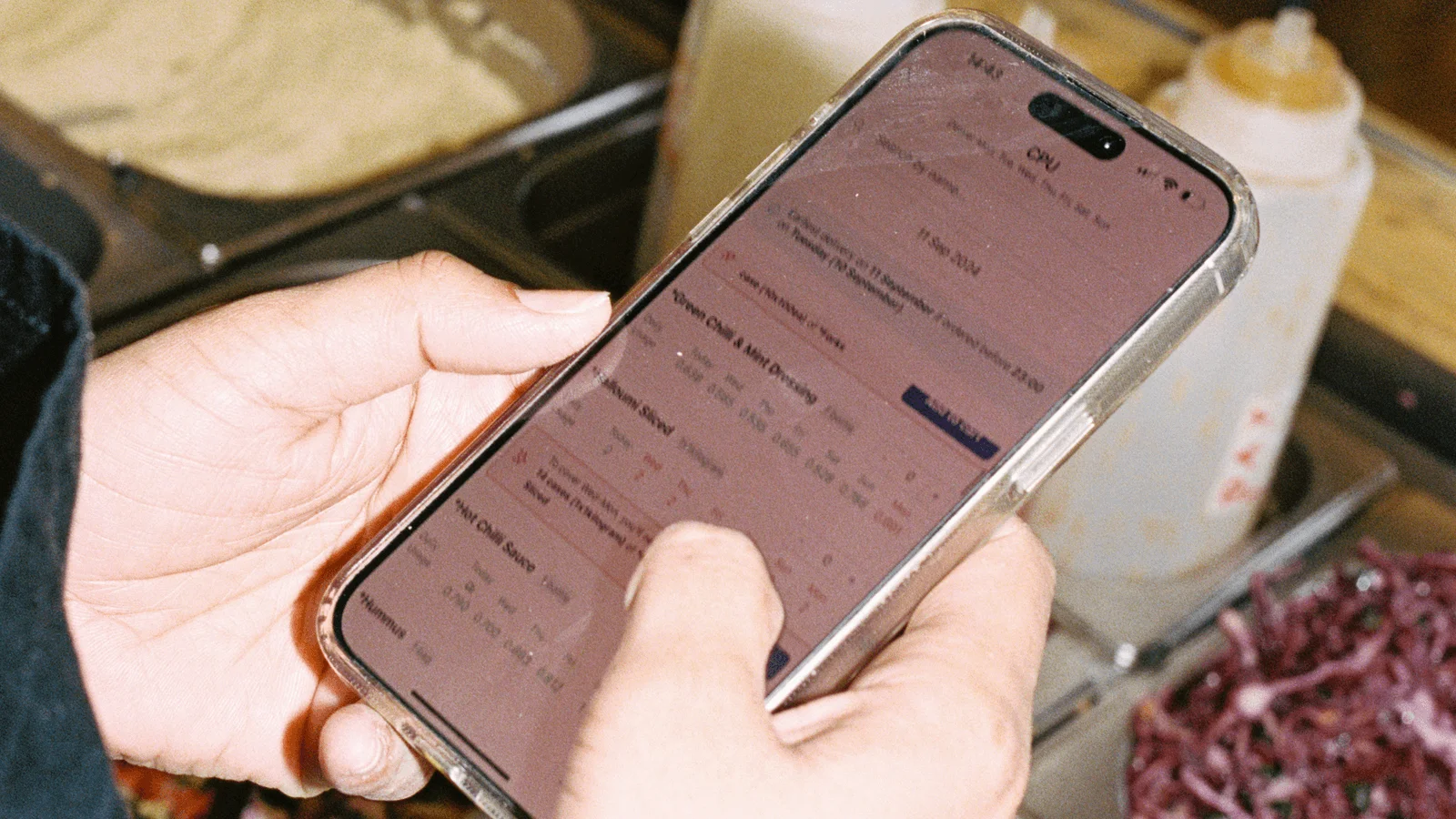
The key shift is simple but important: Ordering moves from a reactive, habit-based task to a forward-looking, demand-driven process.
How Nory’s agentic AI Ordering Assistant works
Nory’s AI Ordering Assistant pulls demand forecasts from the Forecasting Assistant, combining them with recipe-level data to understand exactly what to order to meet demand at each location.
From there, it generates an order that accounts for:
- Expected sales by day and service period
- Recipe consumption rates per dish
- Supplier lead times and delivery schedules
- Minimum order quantities and pack sizes
- Historical variance between forecast and actual usage
The human role then shifts to review and approval. Managers can adjust for nuance (events, promotions, chef changes, or local knowledge), but they’re no longer building the order from scratch or reconciling multiple spreadsheets and systems.
Watch this video for a quick breakdown of how the Ordering Assistant works:
What changes operationally
When ordering becomes demand-driven rather than reactive, the operational impact is almost immediate:
- Food waste drops by ~50%. Orders align more closely with expected demand rather than padded estimates designed to avoid running out. That removes a large amount of over-ordering and spoilage.
- Stock-take labour reduces significantly. Because the software continuously models expected stock positions, teams spend less time manually checking and reconciling what should be there versus what actually is.
- Supplier administration becomes lighter. The system handles purchase orders, invoices, and delivery tracking within a single flow, reducing the need for manual cross-checking between systems.
- Variance becomes easier to understand. Instead of investigating discrepancies across disconnected tools, operators can trace a single chain: forecast > order > delivery > usage. This makes it easier to identify where inefficiencies are actually coming from.
What Nory customers have to say
Across operators using Nory’s Ordering Assistant, the shift is consistent:
- CUPP: 60% reduction in food waste, one of the strongest inventory efficiency gains across the customer base
- Pieminister: Also reduced food waste by 60%, with many sites operating consistently closer to 0.2–0.4% food waste in normal trading weeks
What stays the same for operators
Even with agentic AI, operators design menus, manage supplier relationships, and make decisions about quality, creativity, and what belongs on the menu. The Ordering Assistant doesn’t interfere with those decisions.
What it replaces is the manual workload that sits underneath them, like the mental maths of translating menu ideas into stock quantities and the constant back-and-forth between systems, spreadsheets, and guesswork.
It supports decision-making, but it doesn’t replace culinary judgement.
How will agentic AI influence inventory management in the future?
Today, inventory systems are largely about control: tracking what’s been used, what’s left, and what needs to be ordered. By 2030, we expect that to fully shift into something more continuous and autonomous.
The Ordering Assistant, for example, will operate as part of a connected supply chain system that actively manages ordering and inventory in real time based on sales and demand.
That means:
- Negotiating with multiple suppliers dynamically based on price, availability, and lead times
- Flagging waste patterns automatically before they become structural issues
- Adjusting orders in response to real-time sales and forecast changes
- Coordinating delivery timing and logistics to reduce storage pressure and spoilage
- Closing the loop between forecasting, ordering, and consumption without manual intervention
Inventory management will become a background system that maintains balance while operators focus on decisions that actually require judgement.
To find out more about how agentic AI can streamline your inventory and operations, book a chat with the team at Nory. We’d be more than happy to explore what this could look like for your business.
Read the next blog in our Future of Restaurant Tech series: Why restaurants are moving toward agentic AI systems to manage payroll.