The reinvention of workforce planning with restaurant scheduling AI

The Future of Restaurant Tech series is a field guide for multi-site operators rebuilding for the next decade. Each article looks at what changes when the traditional restaurant tech stack is replaced by an agentic AI operating system.
We break down what each tool in the old stack did, what’s changing, and what the replacement looks like. We also cover migrations, including trade-offs, timelines, and what to keep versus what to replace. By the end, you’ll have a clear view of where restaurant tech is heading and how to think about rebuilding your stack over the next 5–10 years.
1. How agentic AI is upgrading your 2026 restaurant tech stack
2. The reinvention of workforce planning with restaurant scheduling AI
3. Fixing inventory management with agentic AI restaurant ordering
4. Why restaurants are moving toward agentic AI systems to manage payroll
5. Hospitality operators are using real-time restaurant BI: Here’s why
6. The future of restaurant compliance: From manual checks to AI assistants
7. How to migrate from your old restaurant tech stack to an agentic AI operating system
From scheduling tools to an agentic AI Scheduling Assistant
If you ask a general manager or ops manager where their time goes, scheduling is almost always near the top of the list.
Scheduling is repetitive, detail-heavy, and constantly changing. Schedules get built and rebuilt, shift swaps come in, someone calls in sick, or a busy weekend gets re-forecasted halfway through the week.
Every change ripples into labour cost, compliance, and payroll.
Scheduling tools were built to handle that complexity, but they were also designed for a world where humans stitch all the decisions together. They can’t make decisions themselves about how to improve scheduling to optimise labour spend.
Agentic AI changes that starting point.
How agentic AI manages restaurant scheduling
Agentic AI turns scheduling from a manual rota-building exercise into a demand-driven system. The software continuously builds, adjusts, and optimises shifts based on real-time forecasted sales, labour constraints, and team availability.

Instead of managers constructing schedules from last week’s patterns, the system generates a fully formed schedule against expected demand. From here, it keeps refining it as conditions change.
The result is less time spent building schedules, tighter labour alignment, and fewer reactive fixes during the week.
How Nory’s AI Scheduling Assistant turns forecasts into rotas
Nory’s AI Scheduling Assistant builds rotas against accurate forecasts based on live data, not against last week's intuition.
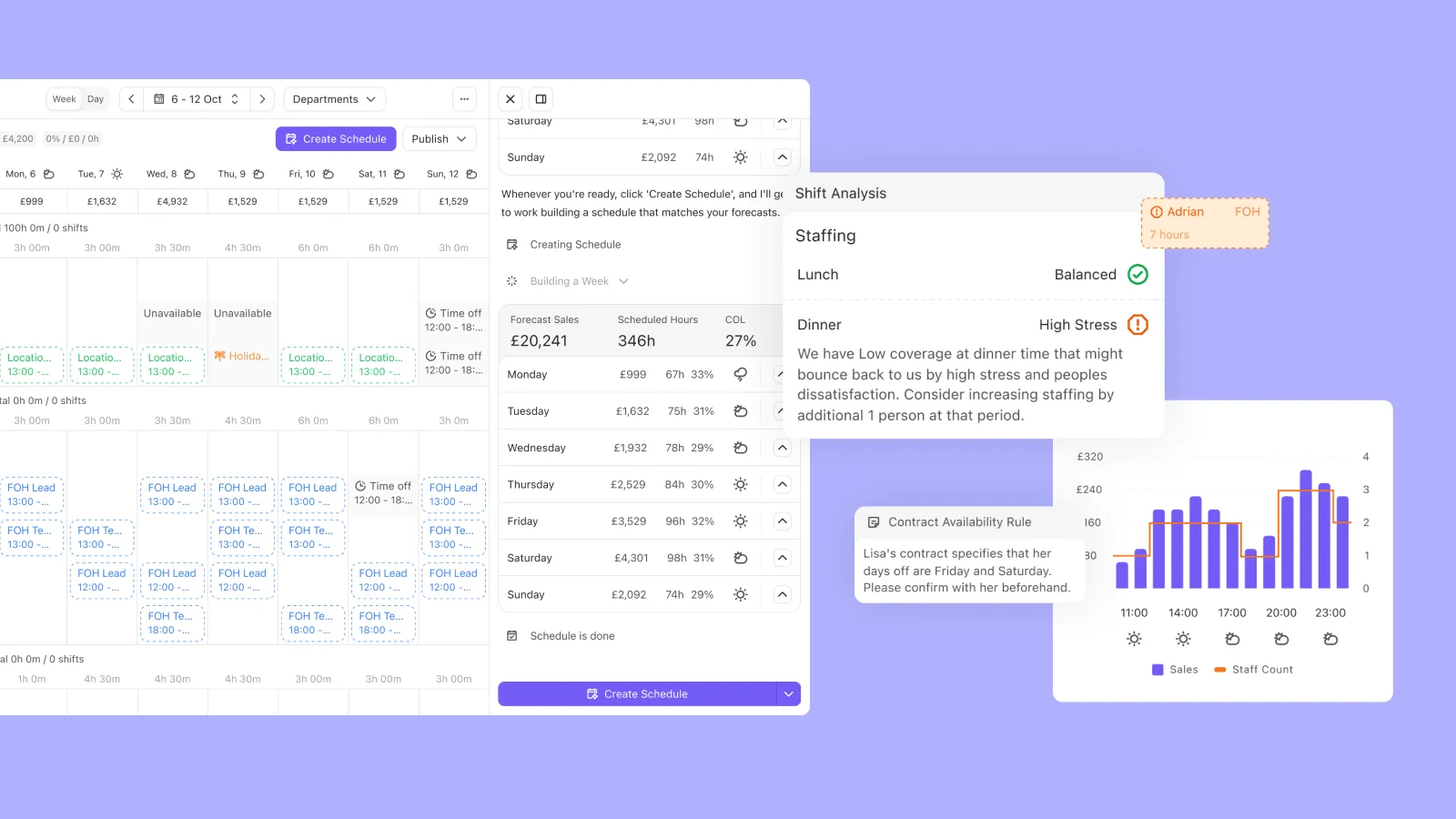
Instead of starting with a blank schedule and working forward, it starts with expected demand for each service period. From there, the software generates a schedule that aligns with labour targets and operational constraints, including:
- Site-level trading patterns (how each location actually performs across days, parts of day, and seasonality)
- Contracted hours and availability (what the team is contracted to work and when they can realistically be scheduled)
- Compliance rules (breaks, working time regulations, age restrictions, and local labour law requirements)
- Skill mix requirements (ensuring the right balance of roles and experience across each shift)
- Historical scheduling accuracy (how previous schedules performed versus actual demand)
The role of people shifts accordingly. Rather than constructing schedules from scratch, managers focus on reviewing, adjusting exceptions, and approving the final schedule.
Watch this video for a full breakdown of how the AI Scheduling Assistant works:
What changes operationally
Once this approach is in place, the operational shift is immediate and measurable:
- Rota creation time drops significantly. What typically takes 4–8 hours per week is now under 30 minutes of review. Managers move from building schedules to validating and refining them.
- Labour cost aligns more closely with demand. Labour percentage typically drops by 10–20% in the first 8 weeks. This happens because staffing levels are based on expected demand rather than conservative overstaffing designed to “play it safe” against forecast uncertainty.
- Mid-week adjustments become data-led rather than reactive. Changes to staffing are triggered by live labour and sales signals, not delayed reports. This means you identify and correct gaps, overstaffing, and coverage issues in real time.
How customers use Nory’s agentic AI to improve performance
The biggest promise of AI scheduling is creating a closer connection between labour and demand.
For decades, restaurants have accepted a degree of overstaffing as the cost of uncertainty. If you're not completely confident in next week's demand, it's safer to schedule extra labour than risk being caught short during service, right?
The problem is that these small decisions add up across sites, weeks, and months.
When schedules are built against accurate forecasts instead of educated guesses, operators can schedule with more confidence. Labour becomes more responsive to actual demand, reducing both unnecessary labour spend and the operational disruption that comes from constantly adjusting schedules after they're published.
We've seen this consistently across operators using Nory:
- Josie’s: 23% labour cost reduction within 4 months
- Barge East: 10% labour reduction driven by demand-based scheduling
- Passyunk Avenue: 26% reduction across multiple locations
When staffing decisions are driven by expected demand rather than intuition, operators spend less time correcting schedules, less time reacting to surprises, and less money carrying unnecessary labour.
What stays the same
The fundamentals of restaurant leadership don’t change. General managers still own service, teams still need leadership, coordination, and judgement in the moment, and service leads still run the floor.
The Scheduling Assistant only replaces the manual process of translating demand guesses into a rota, removing the spreadsheet work but not the responsibility.
What agentic AI scheduling will look like in 2026 and beyond
Today's scheduling tools are already moving managers away from spreadsheets and manual calculations. The next step is moving managers away from building rotas altogether.
Right now, most operators still spend time translating demand into staffing decisions. Even with modern scheduling software, someone has to decide how many people are needed, where they should be deployed, and how labour should be balanced against expected sales.
Over the next few years, that process will become increasingly automated.
As forecasting systems become more accurate, Scheduling Assistants will be able to build, adjust, and optimise rotas continuously. Rather than creating a schedule once a week and making manual changes as circumstances change, operators will work with a living schedule that adapts alongside the business.
Coverage gaps will be identified before they become operational problems. Labour targets will be monitored automatically. Staffing recommendations will adjust as sales forecasts change throughout the week.
Eventually, Scheduling Assistants will communicate directly with team members through in-app chat, proposing shift changes, filling open shifts, and coordinating availability without manager intervention.
Managers will still make the final call on important decisions, but much of the administrative work that sits between planning and execution will happen automatically.
This doesn't mean operators lose control. In many ways, they gain more of it.
Instead of spending hours building schedules, managers can focus on service quality, coaching teams, improving guest experience, and responding to the situations that genuinely require human judgement. Scheduling becomes less about administration and more about oversight.
By 2030, the category we currently call "scheduling software" will likely fade into the background. The operator's primary interaction won't be building schedules. It will be reviewing recommendations, approving exceptions, and managing people.
Curious to find out more about using agentic AI for restaurant scheduling? Get in touch with the team at Nory and we’ll show you how our operating system can help you manage labour and reduce costs.
Read the next blog in our Future of Restaurant Tech series: Fixing inventory management with agentic AI restaurant ordering.