
Why AI forecasting is essential for restaurant success

Restaurant operators are moving beyond traditional analytics and entering a new era of smarter decision-making with AI forecasting (and more specifically, using agentic AI).
So how exactly can operators use this technology to reap these benefits? AI forecasting is becoming essential for restaurants to control costs, reduce waste, and protect margins, but where do you begin?
In this guide, we break down how AI forecasting works, why it matters, and how agentic AI is changing the way restaurants run their operations.
How AI forecasting for restaurants works: A technical overview
AI restaurant forecasting uses artificial intelligence to analyse data and predict future sales, demand, trends, and performance. With this information, you can make quick and informed decisions to cut costs and increase profits.
For example, let’s say that your POS system shows that your most profitable time of the week is Saturday night. An AI system will spot this ahead of time and let you know:
- How much inventory you need
- How to schedule your staff
- What your predicted revenue is
From here, you can take action before service starts. Adjust your orders, prep levels, and staffing plans to match expected demand instead of relying on guesswork.
Take a look at Nory, for example. Our agentic AI operating system analyses your previous restaurant sales, labour costs, productivity, and external factors (like the weather or local events) to accurately predict demand.
As a result, users can:
- Optimise labour costs. Ensure you have the right number of staff to meet demand, but avoid over-scheduling and spending too much on wages (which can dent your profits).
- Improve inventory management. Make sure you have the right amount of ingredients to meet demand without overspending on items you don’t need (which also reduces food waste).
Nory in action: Black Sheep Coffee uses Nory’s AI restaurant sales forecasting to predict demand across its growing estate. As a result, the brand achieved 98% forecasting accuracy and reduced labour cost variance to under 1%.
%20(1).webp)
As we scale, having forecasting, labour and inventory connected in one place means every new site launches into an already established operating model. The controls are already there from day one.
Ula Spire, Head of Operations
What are the benefits of AI forecasting for restaurant owners
AI forecasting helps restaurants make better decisions, faster. By predicting demand, it helps operators plan stock, schedule staff, and control costs with more confidence.
Instead of relying on guesswork, teams can use accurate forecasts to reduce waste, protect margins, and run smoother day-to-day operations.
Let’s take a look at these benefits in more detail.
Improve inventory management with AI forecasting
AI forecasting helps restaurants order the right amount of stock at the right time. By predicting demand, you know which ingredients you’ll need and how much to prepare.
This means less over-ordering, fewer shortages, and reduced food waste.
Nory’s AI Ordering Assistant, for example, uses real-time sales data and inventory insights to recommend what to order and when. It helps operators move away from manual ordering and make smarter purchasing decisions based on what their customers are likely to buy.
Agentic AI systems like Nory can also adapt when demand changes. For example, if sales are lower than expected, the system can adjust recommendations to help avoid unnecessary stock and protect profits.
Side note: Nory’s AI Forecasting Assistant is coming soon! Keep an eye on our website and social channels (like LinkedIn and Instagram) for updates.
Optimise staff scheduling through AI predictive analytics
Agentic forecasting helps you create smarter staff schedules based on expected demand. This means having enough people working during busy periods without paying for unnecessary labour during quieter times.
Labour costs are one of the biggest challenges restaurants face. 18% of restaurant operators list it as one of their top challenges
When you accurately predict restaurant demand, you know exactly how much staff you need in any given shift. This means you can create demand-based schedules to:
- Prevent over-scheduling staff during quiet periods. Staff wages are a big cost for restaurant operators, and even more so with the minimum wage increase this year. If you over-schedule staff, your profits can take a serious hit. But with AI forecasting, you can make sure you only schedule the staff you need.
- Ensure customers have a good dining experience. Under-scheduling might save you some money, but it comes at the cost of the customer experience. AI forecasting helps you create schedules with enough staff to meet demand, so customers are never left waiting for service.
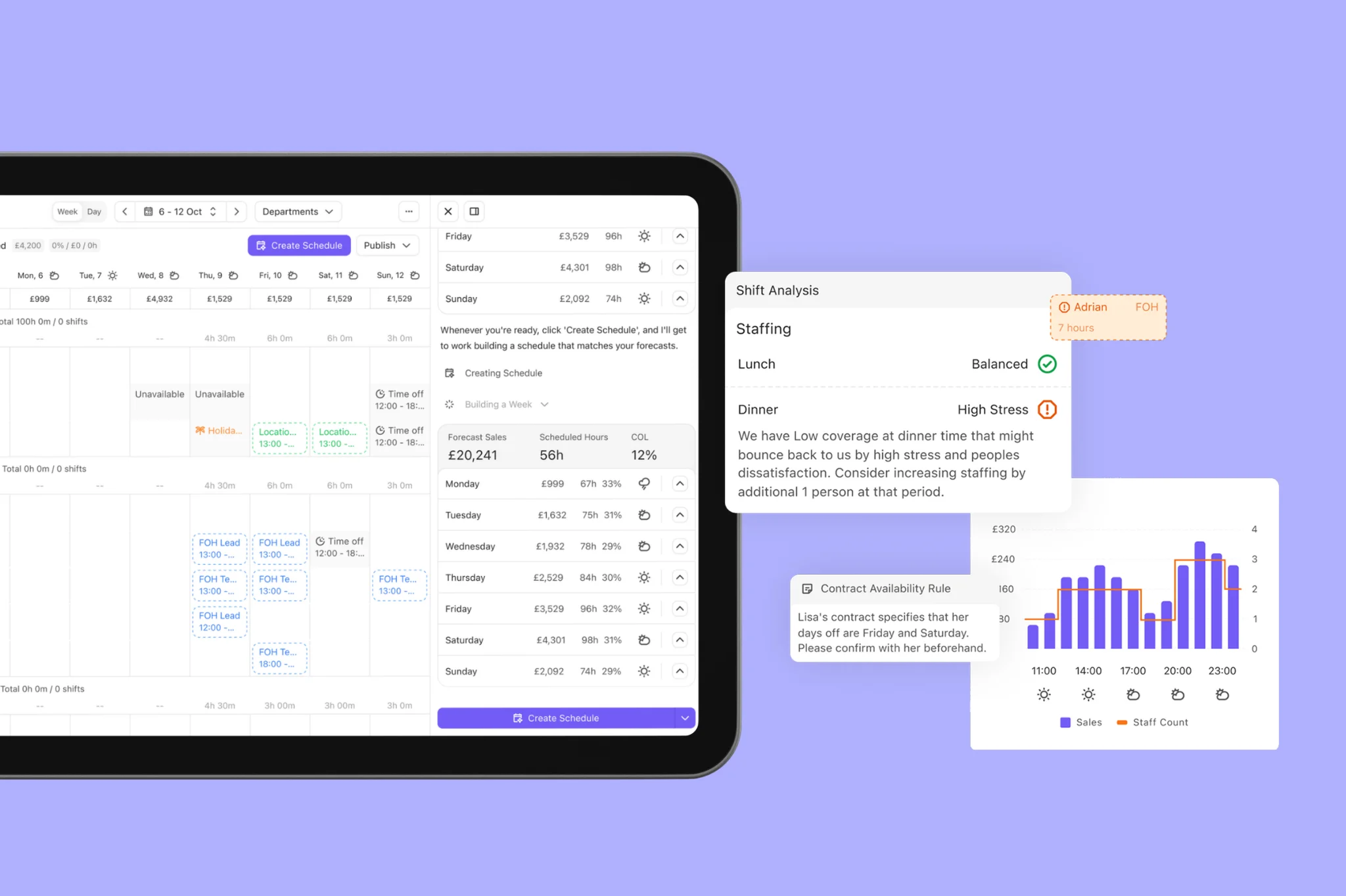
Nory’s AI Scheduling Assistant is particularly helpful here, creating optimised schedules based on real-time performance. It helps you plan shifts faster, reduce manual admin, and make sure staffing matches customer demand.
Nory in action: Discover how Josie’s reduced labour costs by 23% in just four months of working with Nory, plus an increase of 20.% in sales per labour hour!
Reduce human error to improve accuracy
With AI forecasting, you reduce the risk of error and increase accuracy across your entire restaurant operation. The technology uses real data from your previous sales to make accurate predictions, ensuring that all the necessary information is taken into account.
This precision minimises the risk of overestimating or underestimating demand, ensuring that you make informed decisions on inventory, staffing, and ordering.
Nory in action: See how Rocksalt uses Nory’s real-time insights to improve forecasting accuracy by 97.5% and reduce labour costs by 14%.
Because all the ordering and invoices are updated daily, we can catch a price increase from a supplier pretty much instantly. As soon as we spot it, we can react to it immediately.
Stephen Burns, Group Operations Manager at Rocksalt
Enhance the customer experience with AI forecasting
Using AI forecasting helps you create a more consistent experience for customers. When you know what demand looks like, you can prepare properly and avoid issues before they happen.
Providing a good customer experience is one of the core pillars of restaurant success. It can help you get good reviews, encourage repeat business, and build a solid brand reputation that inspires more diners to walk through your door.
But how exactly can AI forecasting enhance the customer experience?
There are a couple of ways:
- Fewer stockouts. Accurate forecasts help ensure popular dishes stay available, so customers can order what they expect.
- Better service during busy periods. By planning staffing levels around demand, teams can reduce delays and keep service running smoothly.
- More personalised experiences. AI can analyse customer behaviour and ordering patterns to help restaurants better understand preferences and create more relevant offers.
Gain a competitive edge in the competitive hospitality market
With an AI-powered system, you can respond faster to market trends and changes. This fast response time ensures you stay relevant and profitable in the competitive landscape.
It’s no secret that the hospitality industry is competitive. As of December 2023, there were 36,000 licensed food-led premises in Great Britain.
And in such a competitive market, restaurants must be nimble and proactive to survive. This means quickly reacting to market changes, optimising costs, and doing whatever you can to gain a competitive edge.
This is where AI forecasting can help, letting you react quickly to trends and opportunities. Whether it’s adjusting staffing, changing orders, or spotting new opportunities, operators can respond based on what’s happening in real-time.
You can also predict customer behaviour, like their preferences or spending habits. With this information, you can provide customers with the best possible experience to stand out from your competition.
AI forecasting tools: What to look for and how to choose the right one
The best AI forecasting systems give you accurate, up-to-date insights you can act on. When choosing an AI forecasting tool for your restaurant, focus on how the technology gets its data, how it fits into your existing operations, and whether your team can actually use it day to day.
Here are some of the key features to look out for when choosing AI forecasting software for your restaurant:
- Real-time data processing. Many tools claim to offer “real-time” insights, but their data may only update every few hours, days, or even months. This means your decisions are based on outdated information. Look for a system that continuously updates with live operational data. For example, Nory updates data every 15 minutes.
- Actionable recommendations. Good AI forecasting software should help you understand what the data means and what actions to take next. Agentic AI systems can turn forecasts into recommendations, letting you adjust ordering, staffing, and preparation plans based on predicted demand.
- Ease of integration. Your AI system should seamlessly integrate with your existing systems, like your POS software. This ensures that the new technology can easily pull real-time data to create accurate forecasts and predictions without causing hold-ups in your operations.
- Real-time data processing. Real-time data is essential for responding to sudden changes and making timely decisions about your profitability. Make sure the system you choose has access to these insights in real-time so you can stay agile and minimise losses.
- User-friendly interface. Choose technology with a simple interface to ensure smooth adoption across your staff. If the system is complex and confusing, it can prevent them from using it effectively. Take a look at Nory’s product tour as an example of an easy-to-use agentic AI system.
Find out more about how Nory uses AI to enhance restaurant operations.
Overcoming challenges in implementing AI forecasting
Implementing AI forecasting doesn’t have to be complicated. The biggest challenges usually come down to cost, team adoption, and data security, but choosing the right technology partner can make the process much smoother!
Let’s break down some of the main challenges and how to overcome them:
Cost of implementation
The upfront cost of AI technology can feel like a barrier, but the long-term value often comes from the savings it creates. By reducing waste, improving labour efficiency, and helping operators make better decisions, AI forecasting can deliver a strong return on investment.
Before investing, calculate the potential impact on your business. Look at areas like reduced food waste, lower labour costs, and improved margins to understand the value the technology could bring.
Side note: Take a look at our success stories to see how other restaurants have reduced costs and increased profits with agentic AI!
Training and adoption
AI forecasting works best when your team understands how to use it and trusts the insights it provides. A smooth rollout depends on giving staff the right training, support, and guidance from the start.
Of course, restaurant teams are busy. Finding time to introduce new technology can feel like another challenge on an already long to-do list.
That’s why it’s important to choose a provider that supports change management, not just software implementation. At Nory, we take a customer-first approach and work closely with operators to help teams confidently adopt the technology and build it into their daily workflows.
Data privacy and security
Protecting your business data should always be a top priority. A reliable AI platform should have strong security measures in place to keep your information safe.
UK restaurants must follow data protection regulations (like GDPR) which set strict rules around how to store, collect, and use personal data. Failing to comply can lead to fines, legal issues, and reputational damage.
When choosing an AI forecasting system, look for strong security features such as data encryption, anonymisation, and clear data management processes.
Case studies: Real operators thriving with AI restaurant forecasting
Let’s take a look at some restaurants that have successfully implemented AI forecasting and seen tangible benefits.
Badiani
Badiani is an authentic gelato shop, with its roots firmly in Italian history. Since launching internationally in 2015, Badiani has grown to 30 stores in 2024.
But managing inventory needs across markets and locations was tricky. They offer different flavours by country and local demographics but didn’t have a centralised system to manage this inventory in real-time.
Fortunately, Badiani partnered with Nory to use our agentic AI to manage its CPU operation. By tracking inventory and sales in one location (and integrating with their POS system, Vita Mojo), Badiani can now create accurate sales forecasts.
Since working with Nory, Badiani has achieved 96% sales accuracy. They optimise their inventory orders and create efficient labour schedules to meet demand. This means preventing overspending on wages during quiet times, which keeps profit margins healthy.
Nory’s agentic AI CPU function with automatic orders is exactly what we wished for.
Faraj, Head of Operations, Badiani UK
Masa
Masa, one of Dublin’s most popular restaurants, experienced growth but noticed issues with their restaurant tech stack. It was disjointed, meaning they couldn’t manage labour costs and inventory effectively. It also made it hard to track the rising cost of goods and expenses, which was cutting into profits.
With Nory’s agentic AI operating system, Masa has been able to overcome these challenges. The restaurant centralised all its restaurant operations with Nory, gaining valuable insights into real-time performance.
Masa has since been able to forecast sales within a 3% margin, and control their labour to within 1% of what they’d planned. These insights have allowed Masa to maintain optimal staffing levels to boost profitability.
Constantly being able to see what your sales are, what your cost of labour is — and trusting that is really valuable.
Shane Gleeson, Owner and Founder at Masa
AI forecasting in the restaurant industry: What’s the latest?
AI is no longer a new concept in hospitality. Restaurants are already using it across areas like forecasting, scheduling, inventory, and operations. The conversation has shifted from “what can AI do?” to “how can operators use it to make better decisions and improve profitability?”
The next evolution is agentic AI. Instead of simply analysing data or showing dashboards, agentic AI systems use real-time operational data to understand what’s happening, recommend actions, and help teams respond faster.
For restaurant operators, this means moving beyond reactive decision-making. Rather than waiting for reports to highlight problems, teams can anticipate demand, adjust staffing, optimise ordering, and protect margins before issues impact the business.
AI isn’t designed to replace the expertise that makes hospitality unique. It works alongside operators, handling complex data analysis so teams can spend more time focusing on customers, people, and the day-to-day decisions that matter most.
Another misconception is that AI is only useful for large restaurant groups. In reality, AI forecasting can help restaurants of all sizes make smarter decisions without needing large teams or specialist expertise.
Whether you’re managing one location or a growing estate, having accurate forecasts can help you control costs, allocate resources effectively, and build a more efficient operation.
The future of AI in the restaurant industry: Trends and innovations on the horizon
Technology is evolving thick and fast, so it’s likely that we’ll keep seeing new trends and changes in how the restaurant industry uses AI over the next few years.
Here are a couple of the things we expect to see.
More automation in the dining experience
With technology streamlining different parts of daily life, diners have higher and more sophisticated expectations when it comes to dining.
As a result, customer-facing technology will likely continue to evolve over the next few years. Outside of automated restaurant forecasting, AI automation will also provide customers with a more personalised dining experience, like providing real-time updates on when food will be delivered to the table.
A continued focus on developing AI technology
The benefits of AI are clear for restaurant operators, so it makes sense that tech providers will continue focussing on how to enhance this technology even further. From back-of-house operations to restaurant processes and workflows, we expect AI technology to keep upping its game in the next few years.
In fact, we’re currently working on some new AI features to disrupt the industry even further.
In March 2024, we secured $16M in Series A funding to spearhead the use of AI in hospitality. Since then, we’ve:
- Tripled revenue
- Expanded into international markets
- Doubled the team
- Proved that a network of AI assistants working 24/7 across restaurant operations can deliver measurable, meaningful impact
And in September 2025, we achieved $37M in Series B funding to:
- Build a world-class data science team
- Expand our AI assistant ecosystem
- Enter the US market (the world’s largest restaurant market)
At a time when hospitality is under pressure, we are putting restaurants back in control of their profitability and their destiny. The future of hospitality isn't robots or gimmicks — it's AI that makes restaurants smarter, leaner, and more profitable, with automation that frees teams up to focus on what matters: great food and even greater customer experiences.
Conor Sheridan, Founder and CEO of Nory
FAQs about AI restaurant forecasting
What type of AI forecasting do restaurants use?
Restaurants use AI forecasting across several areas of their operations. Sales and AI demand forecasting for restaurants are the most common, helping operators predict customer demand and revenue. But AI can also forecast labour requirements, inventory needs, and purchasing, making it easier to schedule staff, order the right amount of stock, and keep costs under control.
The most advanced agentic AI systems (like Nory) bring these forecasts together, so every operational decision is in one location and based on the same real-time data.
What are the disadvantages of AI in restaurants?
The cost of implementation is one of the biggest concerns about implementing AI for restaurants. Although it can feel like a big upfront cost, the return on investment far outweighs the initial setup fee. Over time, a restaurant can reduce costs and optimise spending to increase revenue and boost profit margins.
Can you forecast restaurant sales without AI?
Some restaurants still forecast sales using spreadsheets, historical reports, and their own experience. But these methods are often slower and less accurate, especially when demand changes unexpectedly.
AI can analyse much larger volumes of data in real time, including sales trends, weather, local events, and operational performance. It then turns those insights into recommendations you can act on straight away, helping you make faster and more informed decisions.
Use Nory’s agentic AI to boost your bottom line
AI forecasting helps you stay one step ahead. By predicting demand, you can order the right amount of stock, build smarter schedules, reduce waste, and make more confident decisions every day.
That’s exactly what Nory is built for. Our agentic AI operating system brings together real-time operational data to forecast demand, recommend actions, and help you improve profitability across your restaurants.
If you’re ready to move beyond guesswork, we’re here to help. Get in touch with the team to see how we can transform your restaurant operations.
