
Why restaurants are moving toward agentic AI systems to manage payroll

The Future of Restaurant Tech series is a field guide for multi-site operators rebuilding for the next decade. Each article looks at what changes when the traditional restaurant tech stack is replaced by an agentic AI operating system.
We break down what each tool in the old stack did, what’s changing, and what the replacement looks like. We also cover migrations, including trade-offs, timelines, and what to keep versus what to replace. By the end, you’ll have a clear view of where restaurant tech is heading and how to think about rebuilding your stack over the next 5–10 years.
1. How agentic AI is upgrading your 2026 restaurant tech stack
2. The reinvention of workforce planning with restaurant scheduling AI
3. Fixing inventory management with agentic AI restaurant ordering
4. Why restaurants are moving toward agentic AI systems to manage payroll
5. Hospitality operators are using real-time restaurant BI: Here’s why
6. The future of restaurant compliance: From manual checks to AI assistants
7. How to migrate from your old restaurant tech stack to an agentic AI operating system
Agentic AI systems are transforming payroll for restaurant operators
Restaurant payroll AI systems are quietly reshaping one of the most operationally painful parts of running a multi-site business: paying people accurately, on time, and without losing a day to spreadsheets and reconciliation.
A new wave of AI-driven systems is turning payroll from a manual, periodic process into something closer to a continuous, automated workflow that reflects how restaurants actually operate day to day.
Keep reading to find out what’s in store for restaurant payroll processing and how AI plays a vital role.
From legacy payroll cycles to operational friction
Traditional payroll software was never really designed for hospitality. The systems are made for businesses with clean inputs, stable schedules, and simple employment structures.
As we all know, restaurants are the opposite.
Every pay cycle typically involves pulling data from multiple places. Rota systems, time and attendance tools, tronc arrangements, tip distribution logs, overtime rules, and statutory deductions are just a few examples.
Finance and ops teams then spend hours reconciling mismatches before anything can be approved.
And even small inconsistencies create ripple effects. An incorrectly applied overtime rule or a tronc misallocation can lead to payroll errors that surface after staff receive their payslips. Not ideal for compliance or employee morale.
In many hospitality businesses, this means one or two full days of work per pay run, just to ensure everything balances.
And the larger the operation, the worse it gets. Multi-site groups often multiply the complexity rather than standardising it.
Why hospitality payroll AI is emerging now
The shift toward restaurant payroll AI is driven by a simple operational reality: the data already exists, but it isn’t being used in a connected way.
A lot of restaurants now run highly digitised operations. They build rotas in scheduling tools, track shifts digitally, and access labour data in real time. Yet payroll systems often sit separately, requiring manual transfer and re-entry of information.
This disconnect is where inefficiency lives.
Hospitality payroll AI changes the structure of the workflow. Instead of treating payroll as a standalone process, it connects directly to operational systems and uses the same underlying data that runs the business day to day.
That means:
- Clocked-in hours feed directly into payroll calculations
- Schedules and actual hours are automatically reconciled
- Tronc and tip rules are applied consistently
- Statutory deductions are calculated without manual configuration
Watch this video of how Nory’s AI Payroll Assistant works to see how this works in practice:
In UK and EU contexts, this also includes handling complexity such as HMRC requirements (like PAYE, NIC, statutory pay), BACS submissions, and multi-employer or agency setups.
Historically, these have required heavy configuration or external expertise. AI-based systems increasingly treat them as native workflows rather than edge cases, saving time and stress for a lot of restaurant operators.
What actually changes in day-to-day payroll operations
The most immediate change is time. AI-driven payroll systems can reduce processing to roughly an hour for many operators.
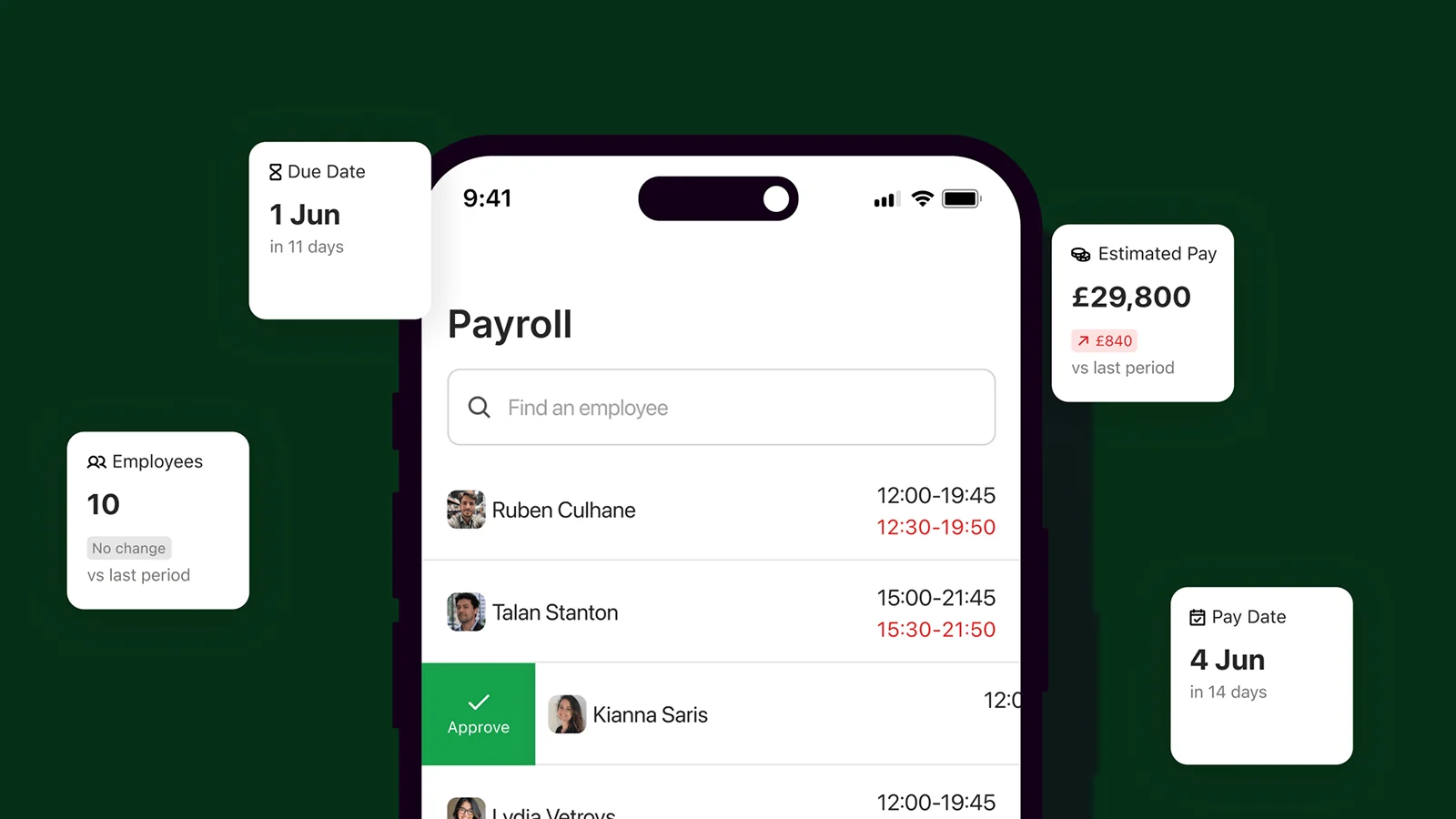
Error reduction is another key benefit.
Because restaurant payroll AI uses the same data sources that drive scheduling and labour planning, there are fewer integration mismatches. The system isn’t comparing inaccurate or outdated information, it’s working from a unified operational dataset.
That consistency significantly reduces the risk of human error.
Another major shift is how complexity scales. In traditional systems, scaling from five sites to fifty usually means adding more payroll effort, more checks, and more coordination.
With AI-powered systems, these challenges aren’t an issue. The workflow remains largely the same regardless of scale, because the system works consistently across locations.
What stays the same: finance ownership and accountability
Finance teams still own the core responsibilities, like managing books, maintaining audit trails, and submitting statutory filings. AI payroll systems don’t replace this accountability layer.
Instead, they prepare cleaner, more structured datasets that make those responsibilities easier to manage. The difference is that teams spend less time fixing upstream data and more time reviewing and approving accurate payroll runs.
The goal of restaurant payroll AI isn’t to remove control from finance teams, but to remove repetitive manual processing that sits between raw operational data and final payroll output.
The long-term direction: Continuous payroll
In the traditional model, payroll happens at fixed intervals. Data is collected, reconciled, processed, and approved in batches. But with AI, payroll is moving from a periodic cycle to a continuous process.
In this continuous model, payroll is always running in the background. As employees clock in and out, the software accrues costs in real time, calculates deductions, and spots variances immediately.
The idea of a “payroll day” is starting to disappear. Instead of a multi-hour or multi-day process every two weeks, payroll can be a short approval step that confirms what the system has already calculated.
Where operators are already seeing the impact
Across the industry, early adopters of AI-powered payroll are already reporting measurable improvements in efficiency and accuracy.
Operators like Roasting Plant Coffee show how using modern payroll approaches can reduce cycle times and simplify multi-site operations.

With Nory’s agentic AI, the business automates payroll processing end-to-end (from schedule data to tronc and statutory deductions), reducing payroll processing time from two days to just one hour.
Nory's Payroll almost pays for itself. It’s accurate, future-proof, and backed by brilliant support.
Kallie Kocourek, Vice President of the UK Market, Roasting Plant Coffee
Roasting Plant Coffee highlights a structural change in how hospitality businesses manage labour costs and payroll workflows at scale.
With the right technology in place, payroll becomes less of a burden and more of a continuous, self-sufficient process.
Closing the loop: From payroll task to operational intelligence
The growing use of restaurant payroll AI represents a shift in how payroll connects to the wider operational rhythm of a restaurant. Instead of treating payroll as a disconnected back-office task, AI systems embed it into the same live data environment that runs scheduling, labour planning, and cost control.
To explore how this shift is being applied in practice, take a look at Nory’s Payroll Assistant.
Our agentic payroll AI automatically pulls clocked-in hours, applies tronc and overtime rules, calculates HMRC deductions, and prepares the full pay run for approval in minutes. Let us handle the manual reconciliation so you can spend less time managing payroll and more time running your business.
Get in touch with the team to see the Payroll Assistant in action.
Read the next blog in our Future of Restaurant Tech series: Hospitality operators are using real-time restaurant BI: Here’s why.