

The Employment Rights Act: Why hospitality operators need to act now

The hospitality sector has absorbed a lot over the last few years. The Allocation of Tips Act, back-to-back National Minimum Wage increases, and employer NIC hikes are a few examples.
And now the Employment Rights Act 2025, the most significant overhaul of flexible working rights in a generation.
For an industry built on zero-hours contracts, seasonal peaks, and last-minute rota changes, parts of this are going to be tricky to navigate. The operators who get ahead of it now will be in a fundamentally different position from those who don't.
Here's what's changing, when it hits, and what to do about it.
What the Employment Rights Act actually says (and what it means for hospitality)
The Employment Rights Act is a new UK law that strengthens workers’ rights and changes how employers manage employment conditions.
The three changes with the biggest day-to-day impact for hospitality operators are:
- Reasonable notice of shifts. Employers must give workers reasonable advance notice of their shifts. Exact notice periods are still being set through consultation (which closes on 25 August 2026), but the framework is clear: you’ll need to justify last-minute rota decisions.
- Payment for shifts cancelled, moved, or curtailed at short notice. Change or cancel a shift without adequate notice and you'll owe the worker compensation (a proportion of the hours they were scheduled to work). Quiet Monday? Kitchen flood? No-show booking? Each one becomes a financial decision, not just an operational one.
- Guaranteed hours for regular hospitality workers. Workers on zero-hours or low-guaranteed-hours contracts who consistently work regular hours over a 12-week reference period will gain the right to a contract that reflects that pattern.
The Act received Royal Assent in late 2025 and is being rolled out in stages through to 2027. Some provisions are already in force, while others are still being finalised in secondary legislation.
Why hospitality will feel the effects of the Employment Rights Act
Most hospitality operating models rely on flexible rotas, zero-hours contracts, and last-minute staffing changes. Around 27% of people on zero-hours contracts in the UK work in accommodation and food, by far the highest concentration of any sector.
With the new Act coming into force, it’ll be harder for businesses to maximise this flexibility (although it’ll protect workers better). Short-notice shift changes might trigger compensation, and consistent working patterns will require formal contracts.
Side note: The enforcement environment is more active than it's been in years. The Fair Work Agency launched in April 2026 with consolidated enforcement powers across NMW, tips compliance, holiday pay, and SSP, and it has the budget and the inspectors to match.
What’s already in force with the Employment Rights Act?
Some Employment Rights Act changes are already in force, while others won’t take effect until 2027.
Statutory Sick Pay (SSP) changed on 6 April 2026, with the three waiting days removed and the Lower Earnings Limit no longer used as an eligibility test. That means eligible employees, including those on variable and zero-hours in UK restaurants, can qualify from their first day off sick.
The bigger changes for hospitality, including shift notice rules and guaranteed hours, are expected in 2027. The finer details (such as notice periods, compensation rates, and thresholds) are still being worked out, with the current consultation closing this month.
How your operating model can help with compliance
The easiest way to reduce compliance risk is to stop relying on last-minute rota changes in the first place. That means getting better at predicting demand, building the right schedule from the start, and having the right information to make changes when you need to.
For hospitality operators, that starts with forecasting. Bookings change, weather shifts, teams call in sick, and sales rarely follow last year's pattern exactly. The better you can predict demand, the less you'll need to rebuild your rota at the last minute.
The practical steps are straightforward:
- Forecast demand before building the rota. Use your sales, bookings, historical performance, and other operational data to see what's coming.
- Build schedules around that forecast. Give managers a schedule that's properly staffed from the outset, rather than one that needs constant last-minute changes.
- Automate compliance checks. Make sure working-time and employment rules are considered as schedules are created and changed.
An agentic AI operating system like Nory can help with these tasks:
- Our Forecasting Assistant predicts demand using your operational data.
- The Scheduling Assistant turns that forecast into a demand-based schedule.
- The Compliance Assistant then helps apply the rules that affect your workforce, so managers aren't left to work everything out manually.
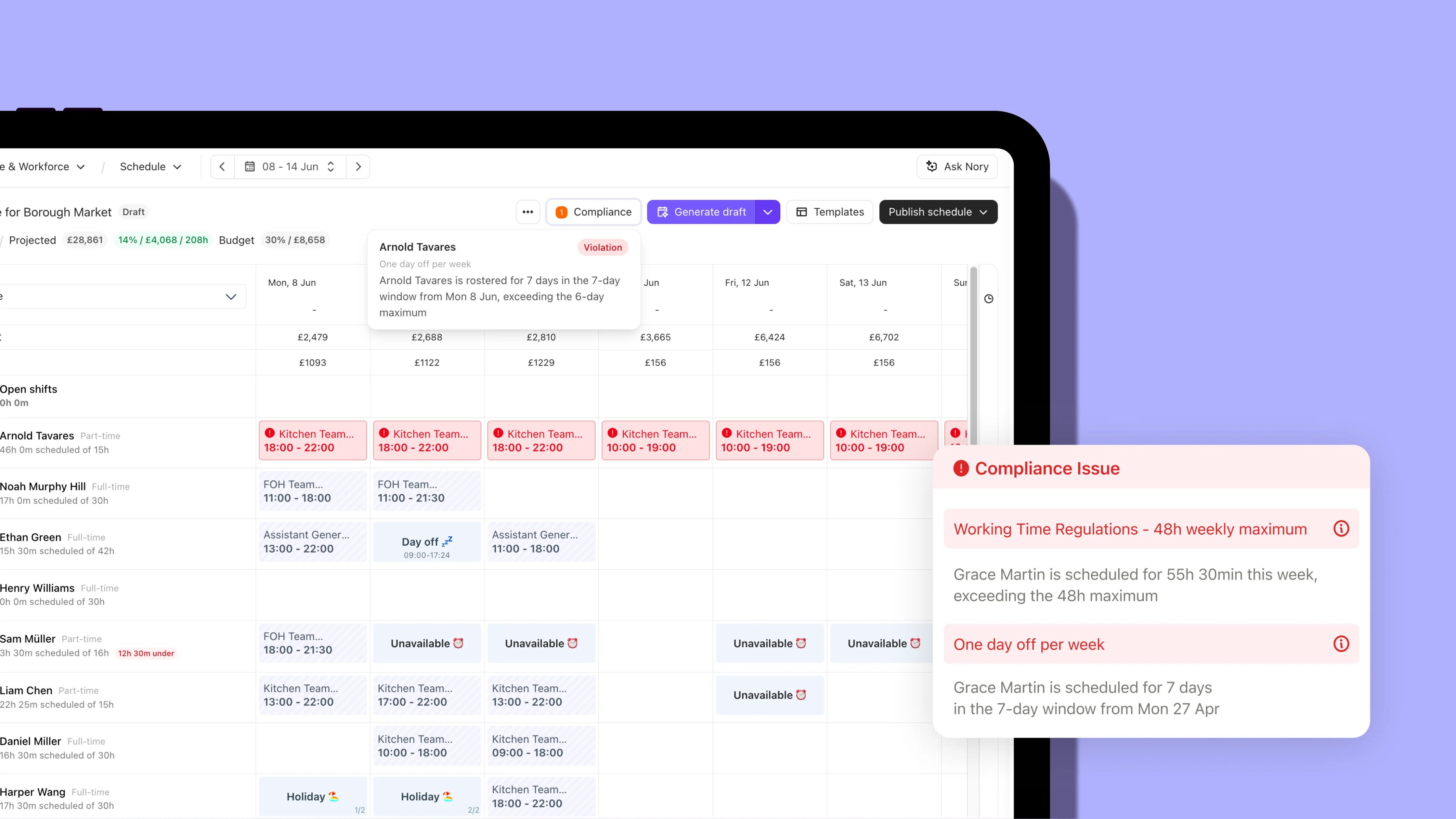
With Nory, operators get real-time insights in one place. As a result, you can forecast demand, build better schedules, and manage workforce compliance without relying on manual processes.
Nory in action: Digbeth Dining Club uses Nory to turn real customer demand into smarter rotas, bringing planned and actual labour costs to within 0.38% of plan, helping the business maintain 70–71% gross profit.
How to prepare for the Employment Rights Act: What to do before 2027
The best way to prepare for the Employment Rights Act is to make your scheduling, contracts, and workforce processes more predictable now.
The practical starting points:
- Start with your scheduling process. If you’re still building rotas by copying last week's and adjusting on the day, that habit is exactly what the new rules penalise. Moving to forecast-led scheduling before the rules land to remove the compliance risk.
- Review your zero-hours arrangements. If team members are working consistent hours, start planning how to formalise those patterns. The guaranteed hours provision will require it; getting ahead of it makes the conversation easier.
- Brief your managers. A large share of rota decisions happen at site level. If your GMs and floor managers don't understand the new rules, the exposure is real. The shift cancellation policy, in particular, needs to be clear before it's tested.
The consultation window is still open, which means the exact notice periods and compensation rates aren't yet set. However, you don't need to wait for every detail of the Employment Rights Act to be finalised before you start preparing.
The sooner you start changing the way you manage rotas and workforce data, the easier 2027 will be.
Get ready for the Employment Rights Act with Nory
The Employment Rights Act doesn't have to be a disaster. For operators who are building schedules from demand and give their teams predictability, the practical impact is small.
The businesses that will struggle are those who depend on flexibility. The window to change that model is right now, while the rules are still being finalised and before enforcement begins.
This is where Nory can help. Our agentic AI system connects forecasting, scheduling, compliance, and payroll in one place. As a result, you build rotas right the first time, inside the rules that apply, with no manual intervention required.
Book a chat with the team to see how Nory helps operators get ahead of the Employment Rights Act.
This post is for informational purposes and does not constitute legal advice. For guidance specific to your business, we recommend consulting an employment lawyer or HR advisor.