How to catch supplier invoice errors before they hit your P&L

Supplier invoice checking looks straightforward until you’re doing it across 10, 20, or 30 sites.
Every invoice needs to be checked against what you ordered and what actually arrived, but the process gets harder to keep up with as the business grows.
This article explains why manual restaurant invoice processing breaks down at scale, how small supplier price changes can quietly eat into margins, and what a proper three-way matching process needs to work.
The key is simple: you can’t check whether a supplier charged the agreed price unless your system knows what that price was in the first place.
Why checking every supplier invoice stops working when you grow to multiple sites
Manual invoice checking becomes harder to keep up with as you add new locations. More sites mean more supply chains, more deliveries, and more invoice lines to work through. Checking every invoice becomes unrealistic, and the team starts relying on spot-checks instead.
At its simplest, the job is straightforward. Someone finds the purchase order to see what was agreed, checks the goods received note to see what arrived, then compares both against the supplier’s invoice. It’s a line-by-line check across three documents.
At three or four sites, that’s usually manageable. At around 10? It starts to become painful. By the time you’re running 30+ sites, there’s more invoice lines coming in each week than anyone has the capacity to check properly.
That’s when the process changes without anyone making a conscious decision.
Full checks become spot-checks. Before long, invoices are being approved because they look right, rather than because someone has actually verified them.
Recommended reading: A guide to managing hospitality teams across multi-location restaurants.
What manual invoice checking actually costs a restaurant group
Manual invoice checking hits the bottom line in two places: the finance time it consumes and the supplier overcharges that spot-checking can miss.
Let’s look at these in more detail.
First, there’s the finance team’s time
For every invoice that gets a proper review, someone needs to find the purchase order, check the goods received note, then compare the invoice against both, line by line. In a growing multi-site group, that means the workload keeps building with every site, supplier, and delivery.
Your restaurant accounts payable team ends up spending more of its week pulling documents together and chasing missing information, leaving less time for the work that actually helps protect margins.
Then, there’s the cost of what doesn’t get checked
Supplier price drift is the gap between the price you agreed and the price that appears on the invoice. Left unchecked, it can quietly chip away at gross profit across every site.
But when the volume becomes too much, spot-checking is the natural fallback. Most invoices are fine, but the occasional price or quantity discrepancy can slip through. A small overcharge on one invoice becomes much more significant when it’s repeated across multiple sites and deliveries.
Say a supplier agrees to charge £10 for an item, but starts invoicing it at £10.20. That 2% difference might not look worth chasing on a single delivery. It’s small enough to get lost among the other lines on an invoice, especially when the finance team is already working through a stack of them.
Now multiply it across a multi-location restaurant. If one supplier’s invoices run 2% above the agreed price, a £900 weekly invoice becomes £918. Across 10 sites, that’s £180 a week, or £9,360 a year, from one supplier alone.
The problem is that the £9,360 doesn’t appear as a single cost anywhere. It shows up gradually as supplier price creep, reducing gross profit and increasing supplier spend. Repeat that across several suppliers, and those small discrepancies can become a meaningful drag on margin without anyone making a conscious decision to pay more.
What this means for operators: Either you keep checking everything and absorb the admin, or you check less and accept there’ll be some discrepancies and overspending.
Or, you can use an agentic AI restaurant invoice management system to handle the process for you (more on this later).
Recommended reading: How Nory uses AI to enhance restaurant operations
Why most invoice tools can’t verify your invoices correctly
You can’t verify an invoice price unless your system knows what you agreed to pay. That information sits on the purchase order, not the invoice.
A system can read an invoice and tell you exactly what the supplier has charged. But unless it can compare that figure with the agreed price on the purchase order, it can’t tell you whether the charge is correct.
That’s the difference between a two-way and three-way match:
- Three-way invoice matching for restaurants cross-checks the purchase order, goods received note, and invoice. It checks the price against the order and quantity against what was delivered.
- A two-way match, where there’s no purchase order, compares the goods received note with the invoice and checks quantity only. It still catches genuine problems (particularly when you’ve been billed for more than you received), but it doesn’t verify the price.
An invoice can pass a two-way match because the quantity is correct, while the supplier is charging more than the agreed rate. Without the purchase order, there’s simply no reference point for the price check.
Why the right technology is a game-changer for managing supplier invoices
The best invoice management systems handle purchasing, goods receiving, and invoice processing in the same platform. The software takes care of the manual work from start to finish, flagging anything that needs attention.
This functionality means that your team doesn’t have to jump between systems to check documents against each other. The information is already there, so the system can match what you ordered, what you received, and what you’ve been charged.
Take a look at Nory as an example. In our agentic AI operating system, all of these steps connect. Your team creates the purchase order when it places the order, records the delivery when the goods arrive, and sends the invoice through the same system.
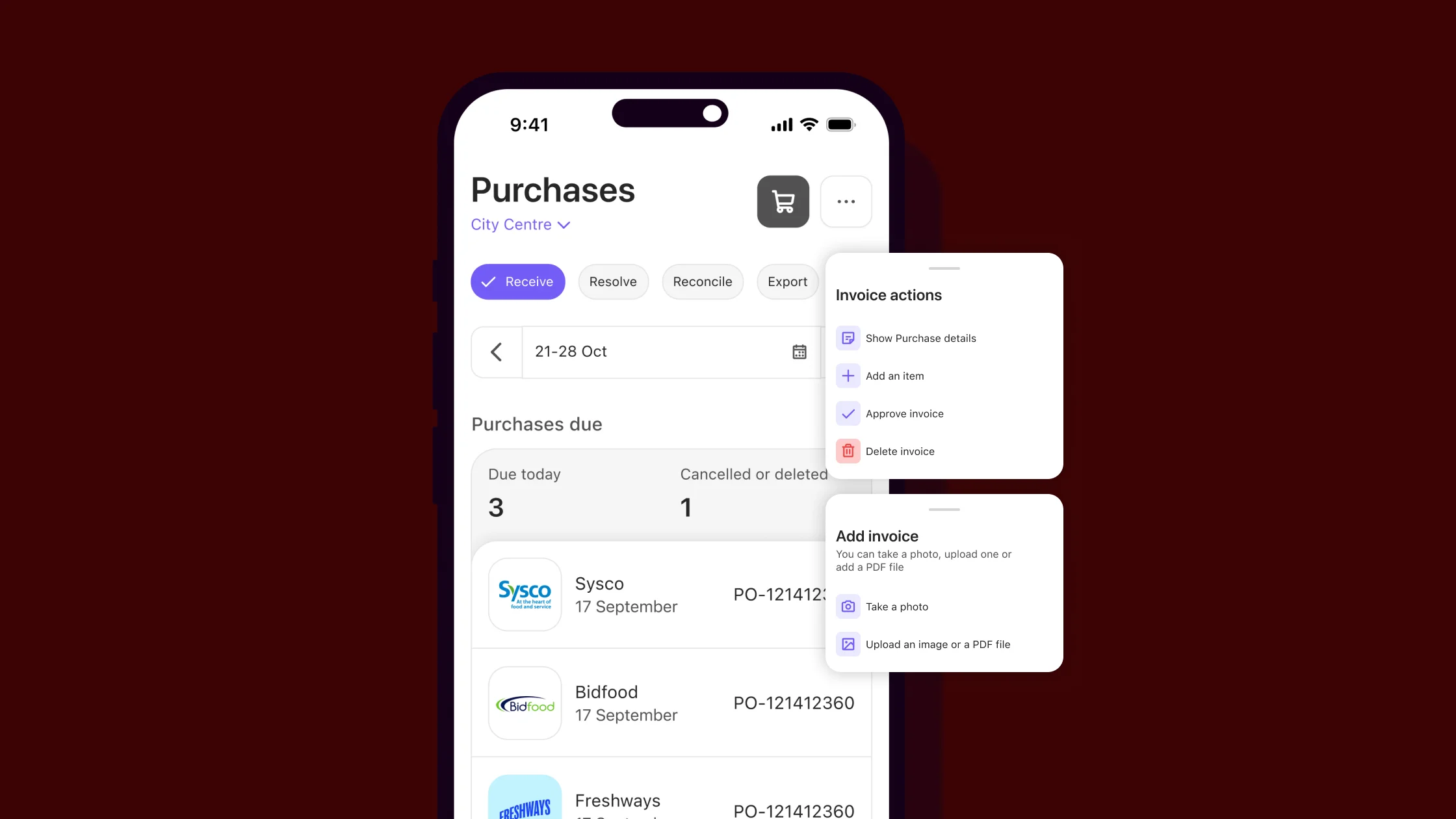
By the time finance sees the invoice, Nory already has the information it needs to check it.
This means that finance teams no longer have to pull three documents together and compare them line by line.
And that connected view isn't limited to the finance desk. Because the order, delivery, and invoice already live together, a multi-site operator can see flagged price and quantity discrepancies from their phone the moment they arise, so a problem spotted on the floor at a delivery gets actioned there and then, not at the end of the week.
FAQs about restaurant invoice management
What is three-way matching in accounts payable for restaurants?
Three-way matching in restaurants means checking the purchase order, goods received note, and supplier invoice against each other. If everything matches, the invoice is clean.
How can restaurants track supplier price changes automatically?
By using the right technology. With the right system, you can compare each invoice line with the agreed price on the purchase order. If the price has changed, the system flags it before approval.
What invoice capture and approval features should restaurants look for?
Use technology to automate the matching instead of checking every invoice manually. When ordering, goods receiving, and invoicing are in the same system, you can automatically match invoices against what you ordered and received, reviewing only the price or quantity discrepancies that get flagged.
How do supplier price changes affect restaurant profit margins?
Even small price increases can eat into gross profit when they repeat across sites and deliveries. A 2% increase might barely register on one invoice, but across a large mult-site group, it’s a significant cost.
What is supplier price drift, and why is it hard to spot?
Supplier price drift is the gap between the price you agreed and the price you’re actually charged. It’s easy to miss because each difference can look insignificant until it repeats across sites, suppliers, and deliveries.
How do you reduce the time spent reconciling inventory counts with vendor invoices?
Connect ordering, goods receiving, and vendor invoicing in the same system. The software can then match invoices against what you ordered and received automatically, so your team can just review discrepancies.
What is the best stock control and invoicing software for UK restaurants?
Look for a system that has ordering, inventory, goods receiving, and invoicing built into the platform. Centralising this data means you can easily check what you ordered, what arrived, and what the supplier charged in one place.
Recommended reading: How restaurant stock management software can cut costs (+ 3 tools worth using)
What is a typical restaurant invoice approval process?
A typical process checks the purchase order, goods received note, and supplier invoice before payment. A three-way match checks the price against the order and the quantity against the delivery, then flags anything that doesn’t match.
How do you catch supplier overcharging in a restaurant?
Compare every invoice against the price agreed on the purchase order. A three-way match checks both price and quantity before approval, so your team can review discrepancies before paying the invoice.
Can I manage restaurant invoices on mobile?
Yes, with an invoice management system has a mobile app. For multi-site operators who spend far more time on the floor than at a desk, mobile access means you can review flagged discrepancies, check what was ordered against what was delivered, and keep approvals moving from any site. The visibility that protects your margins is most useful when it's in your pocket, not locked to one office computer.
Stop checking every invoice and start catching the ones that matter
As your restaurant group grows, manually checking every invoice gets harder to manage. If you resort to spot-checking, you risk letting small price and quantity discrepancies pile up and eat into your bottom line.
For a long time, technology simply hasn't been in a position to close that gap. But the good news? Nory Invoicing Assistant is bringing those pieces together.
Stay tuned to see how Nory’s Invoicing Assistant works to spend less time checking invoices and more time dealing with the ones that need attention.